Does Filler Complicate Your Facelift Later?
With Dr. Lara Devgan, Board-Certified Plastic Surgeon
This is one of the most common—and smartest—questions patients ask: If I get filler now, am I making surgery harder later? The short answer is it depends. The longer, more important answer is about which treatments, how they’re used, and who’s guiding your long-term plan.
Dr. Lara Devgan breaks it down.
1. What Treatments Can Cause Issues Later?
Not all injectables are created equal, and not all filler use is strategic.
The treatments most likely to complicate a future facelift include:
Excessive or repetitive filler placed in the wrong planes, especially deep or structural areas of the face where surgical dissection later occurs
Permanent or semi-permanent fillers, which can integrate into tissue and distort anatomy over time
Overfilled midface, jawline, or temples, leading to stretched skin, altered contours, or fibrotic tissue
The issue isn’t filler itself—it’s poorly planned filler. When filler is layered year after year without regard for anatomy, aging patterns, or future surgery, it can blur natural planes, obscure landmarks, and make surgical correction more complex.
By contrast, appropriately placed, conservative hyaluronic acid filler, used judiciously and allowed to metabolize naturally, rarely causes meaningful problems during facelift surgery—especially in the hands of an experienced surgeon.
2. How Do You Maintain Youthfulness From Age 60 and Beyond?
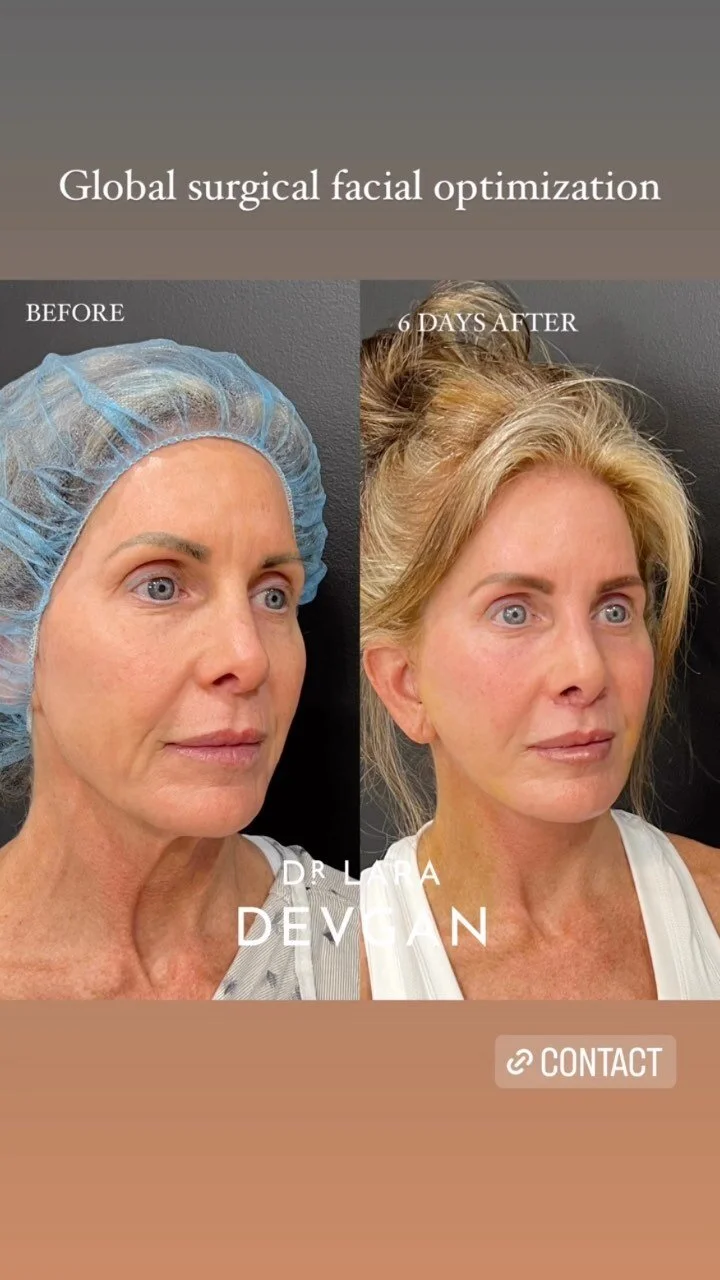
A facelift is not a magic eraser—it’s one part of a lifelong strategy.
Patients who age best over decades typically follow a layered approach:
Early decades (30s–40s): Skin quality, collagen preservation, sun protection, subtle neuromodulators, light filler where needed
Midlife (40s–50s): Strategic volume support, energy-based skin tightening, biologic skin health, and restraint
Later decades (60+): Surgical lifting to restore anatomy, paired with conservative nonsurgical refinement
What matters most is preserving tissue integrity. Over-filling in place of lifting eventually backfires. Gravity always wins. A facelift works best when the skin and deeper structures haven’t been chronically distorted by excess volume.
Patients who transition thoughtfully—using nonsurgical treatments to support, not replace, surgical options—tend to look more natural, rested, and youthful long-term.
3. How Do You Use Nonsurgical Treatments Now Without Burning Bridges Later?
This is where physician choice matters most.
The safest way to enjoy nonsurgical procedures today without compromising surgical options tomorrow is to work with a board-certified plastic surgeon who performs both.
Why? Because they understand:
Facial anatomy at surgical depth
How today’s filler placement affects tomorrow’s dissection
When not to inject
When filler should be dissolved rather than layered
When surgery is the more honest solution
A surgeon-injector plans with the end in mind. They don’t chase trends or inflate faces. They prioritize balance, reversibility, and anatomical respect.
In many cases, Dr. Devgan recommends:
Using small amounts of hyaluronic acid filler, placed superficially and selectively
Avoiding permanent fillers entirely
Allowing filler to naturally metabolize as patients approach surgical age
Dissolving residual filler before facelift surgery when appropriate
This approach keeps surgical planes clean and results predictable.
The Bottom Line
Filler does not inherently ruin a future facelift. Poor planning does.
When injectables are used thoughtfully—and guided by a surgeon who understands both nonsurgical finesse and surgical precision—they can be part of a smart, long-term aesthetic plan.
The key is choosing a physician who isn’t just treating your face today, but is designing a custom roadmap for the decades ahead.
Seeing a board-certified plastic surgeon experienced in both surgical and nonsurgical procedures allows for exactly that: a fully personalized, intelligently sequenced future of care—without shortcuts, regrets, or burned bridges.
A youthful result isn’t about doing more.
It’s about doing the right thing, at the right time, with the right expert guiding the way.
Appointment Inquiries
For inquiries and appointments, please email appointments at appointments@laradevganmd.com or call 212-452-2400. You may also use the following button to schedule an appointment online. We look forward to hearing from you. Thank you!