Signature Procedure | The First Week After Eyelid Surgery: What Healing Really Looks Like

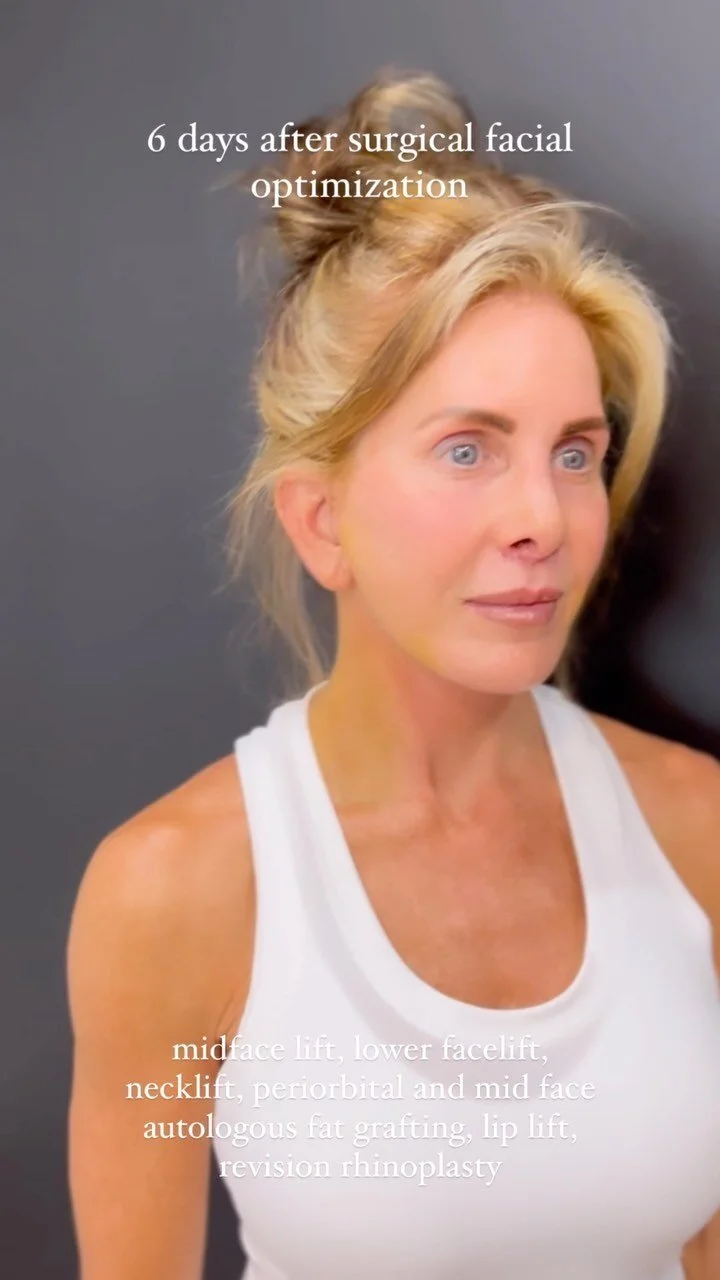
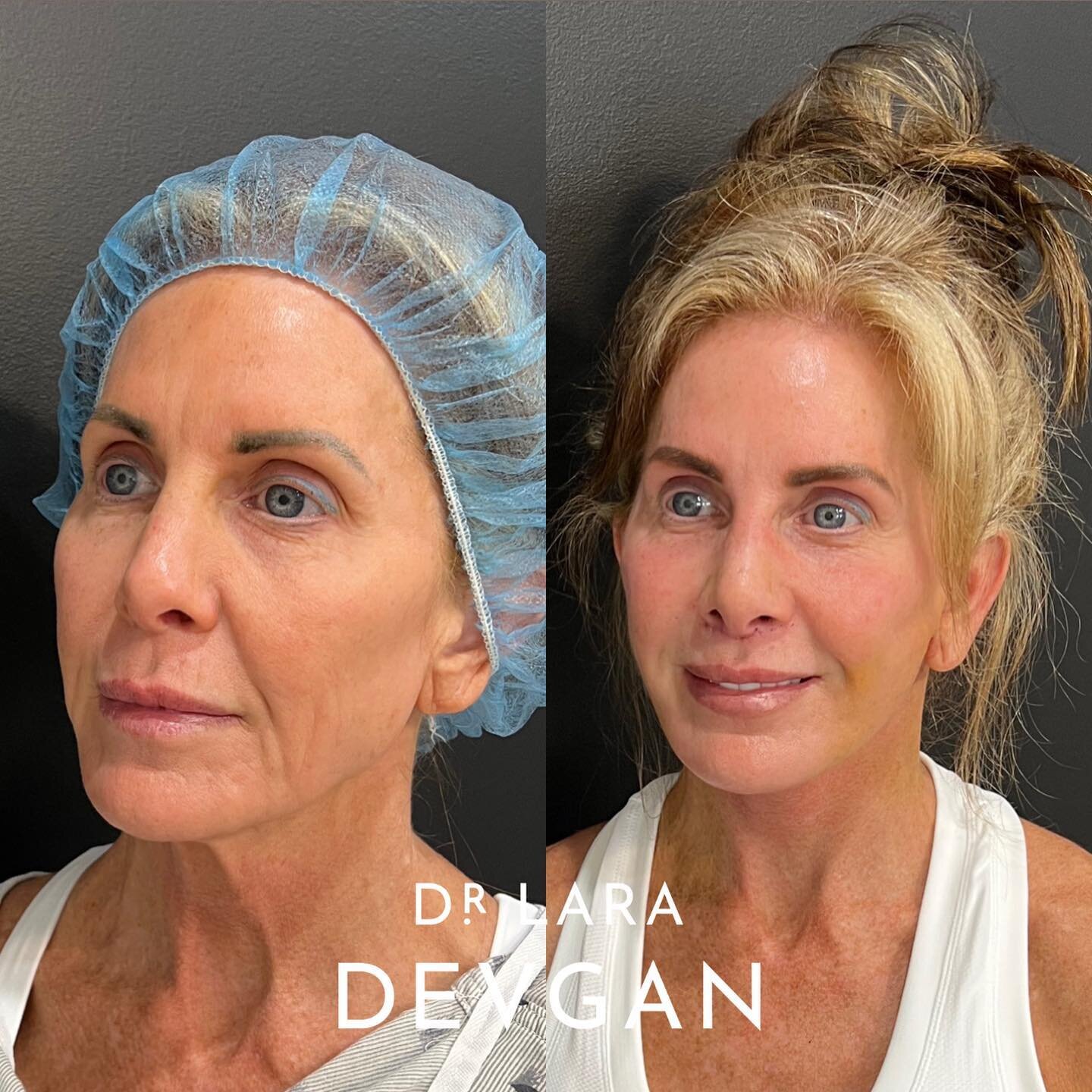
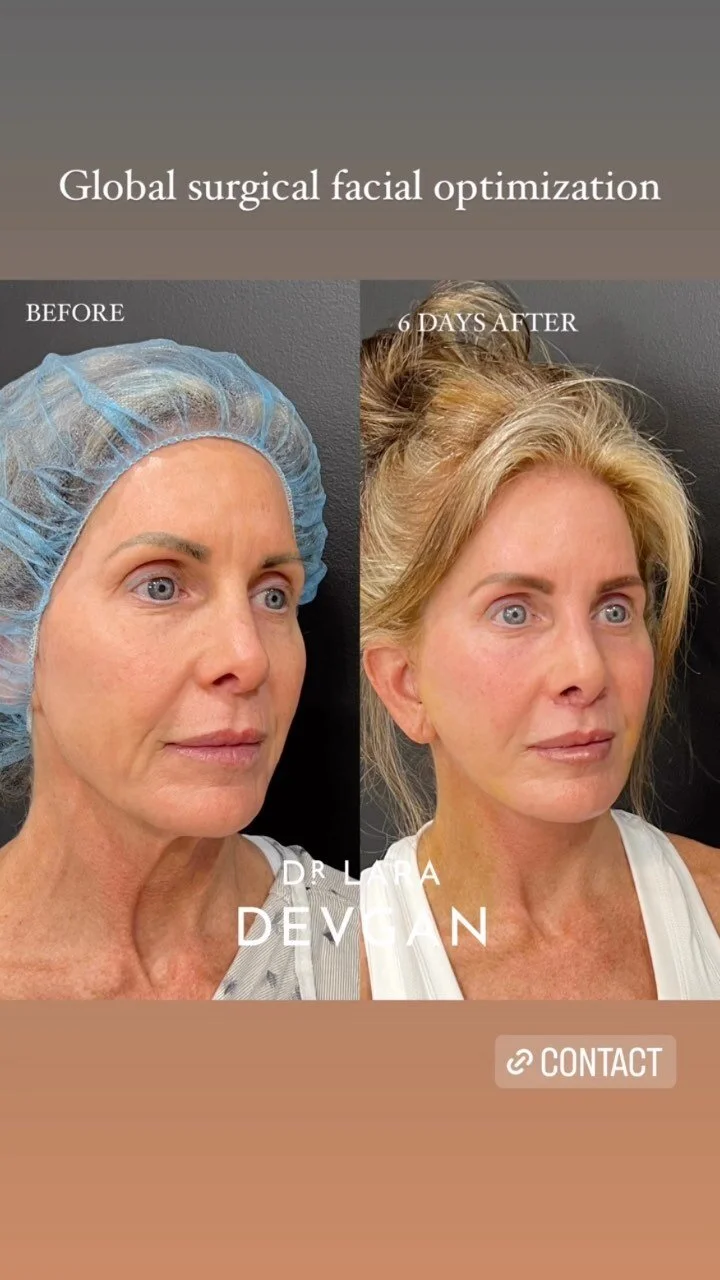
In this TikTok, Dr. Lara Devgan highlights her Signature Blepharoplasty Procedure and the recovery process using a series of before & after images.


The First Week After Eyelid Surgery: What Healing Really Looks Like

The first week after eyelid surgery is where transformation begins—but it’s also where patience is tested.

Swelling, bruising, and asymmetry are completely normal at this stage. While patients often expect instant results, the reality is that the early healing phase is just the foundation for what’s to come. Understanding this timeline is key to appreciating the final outcome.

A Real Patient Example

In this case, the patient underwent a comprehensive periocular rejuvenation:

  • Upper eyelid blepharoplasty

  • Lower eyelid blepharoplasty

  • Autologous fat grafting

  • Lateral canthopexy on the right side to improve lower lid symmetry

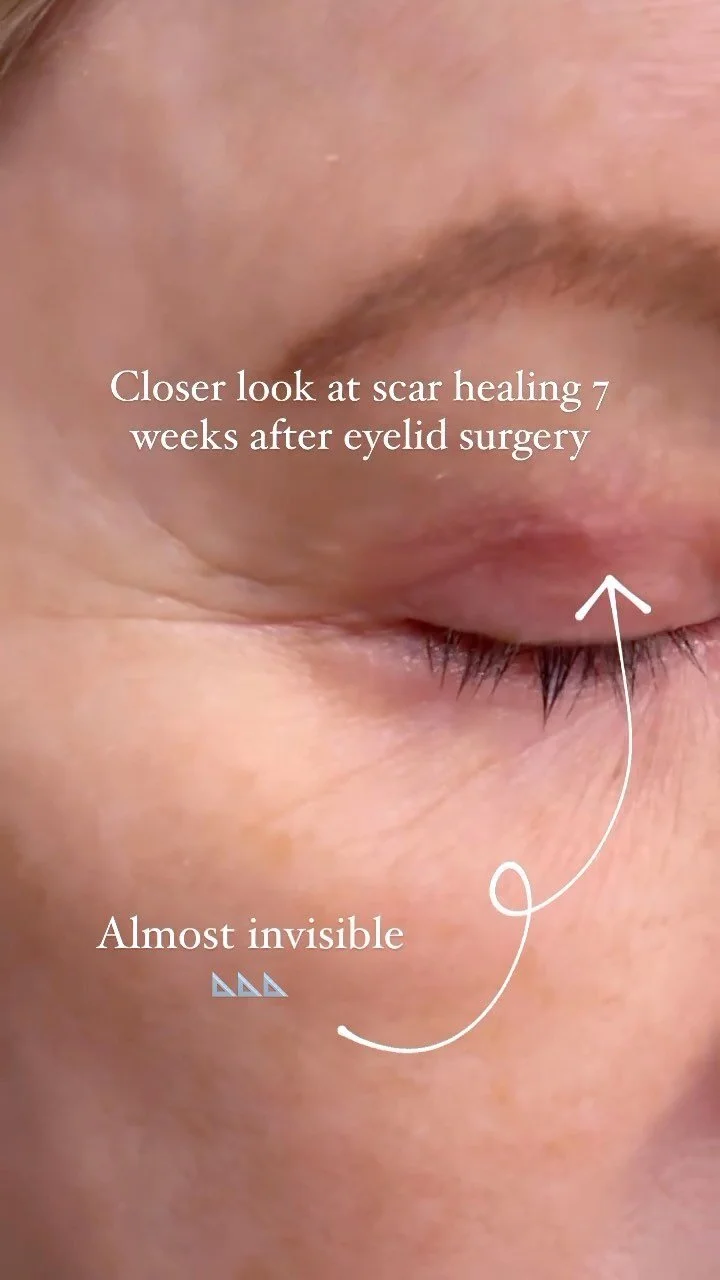
Even at just one week post-op, there is still visible swelling—especially in the lower eyelids, where fluid tends to accumulate the most. Bruising may still be present, and the tissues are actively adjusting.

And yet, something important is already happening.

The eyes look fresher.
The contours are more balanced.
The symmetry is beginning to emerge.

That’s the signal—not perfection, but direction.

What’s Happening Beneath the Surface

At one week, the body is deep in the healing process:

  • Inflammation is still elevated

  • Lymphatic drainage is gradually improving

  • Fat grafts are beginning to integrate

  • Incisions are closing and strengthening

This phase is less about aesthetics and more about biology doing its job.

The visible swelling can obscure results, but it doesn’t erase them.

Why Patience Matters

Eyelid surgery is not a quick-fix procedure—it’s a progressive refinement.

  • Weeks 2–3: Swelling starts to noticeably decrease

  • 1–2 months: Contours become more defined

  • 3–6 months: Final results begin to fully reveal themselves

Every patient heals differently. Factors like skin thickness, surgical complexity, and individual biology all play a role in the timeline.

Trying to judge results too early is like evaluating a film before post-production is finished.

Early Results vs. Final Outcome

Even in the presence of swelling, experienced eyes can spot early success:

  • Improved eyelid position

  • Better lower lid support (especially after canthopexy)

  • Smoother transitions between eyelid and cheek

  • More rested, alert appearance

These early indicators are often more meaningful than temporary swelling or bruising.

The Takeaway

The first week after eyelid surgery is not about the final look—it’s about the trajectory.

This patient is still in the early stages of healing, but the direction is clear: improved symmetry, enhanced support, and a more refreshed appearance. As the swelling continues to resolve over the coming months, these results will only sharpen and refine.

If you’re considering eyelid surgery, or currently in recovery, understand this: the process rewards patience. What you see in week one is just the opening scene.


Appointment Inquiries

For inquiries and appointments, please email appointments at appointments@laradevganmd.com or call 212-452-2400. You may also use the following button to schedule an appointment online. We look forward to hearing from you. Thank you!

Doctor's Notes | The Nose as the Architectural Centerpiece of the Face

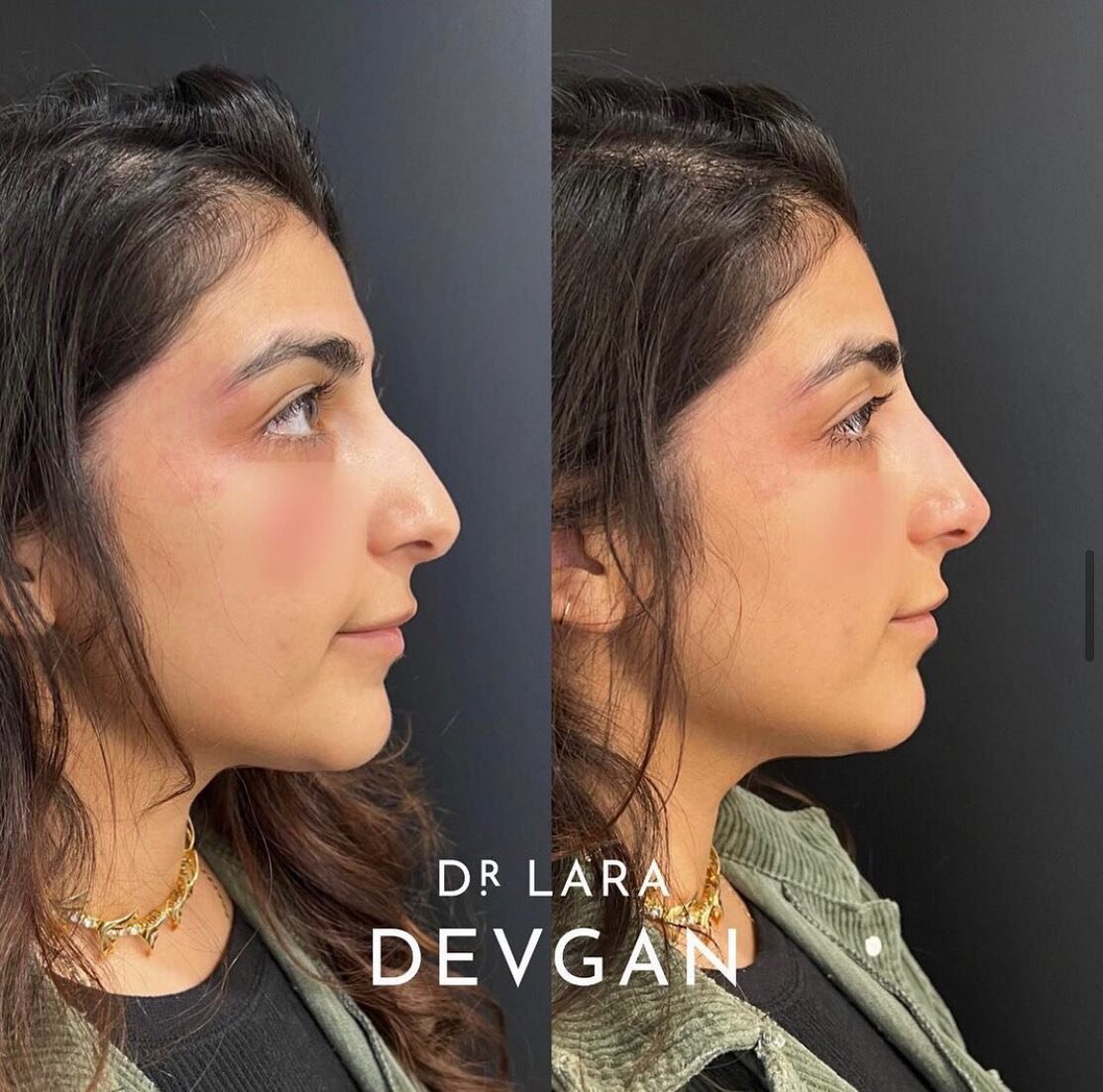
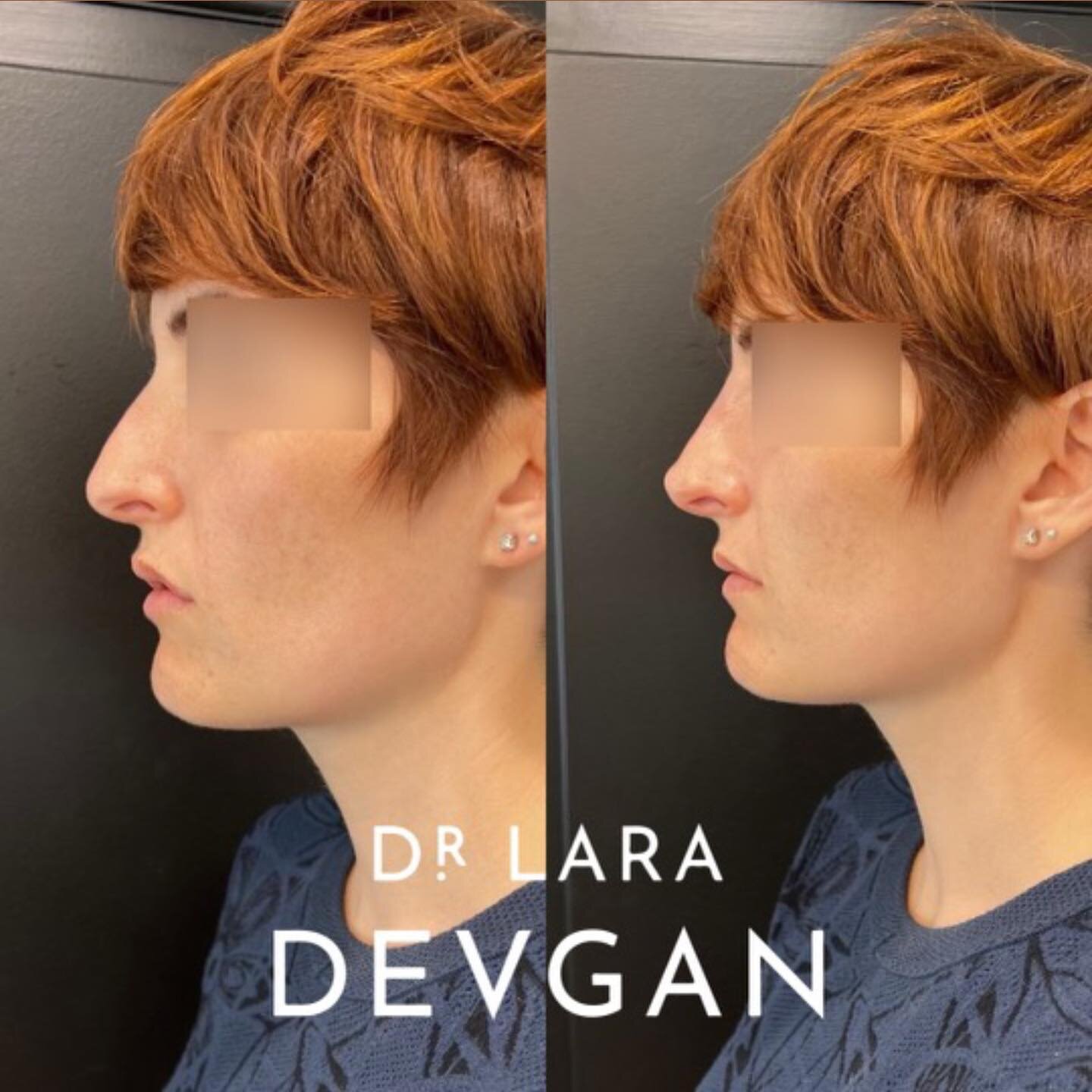
In this TikTok, Dr. Devgan breaks down the importance of the nose in facial identity, attractiveness, and biological/cultural meaning and how it relates to her work as a plastic surgeon.


The Nose as the Architectural Centerpiece of the Face

The nose is not just another facial feature—it is the structural and visual anchor of the entire face. Positioned at the exact intersection of the most important facial proportions, it quietly organizes how every other feature is perceived.

It sits between the eyes, defines the midline, relates directly to the projection of the chin, balances the width of the mouth, and interacts with the slope of the forehead. In this sense, the nose is not isolated anatomy—it is geometry in three dimensions, embedded in a living composition.

When it is in harmony, it disappears.

Not literally, of course, but perceptually. The eye stops registering the nose as a focal point and instead moves fluidly across the face—the eyes become more expressive, the smile more dominant, the overall identity more cohesive. The face feels balanced, even if the observer cannot articulate why.

When it is out of harmony, the opposite happens. The nose begins to dominate perception. Not necessarily because it is large or overtly irregular, but because it disrupts proportion. Facial balance is not about size alone—it is about relationships. And when those relationships are off, even subtly, the entire visual system locks onto that imbalance.

This is why the nose holds such unique power in facial aesthetics. We do not evaluate features independently. We perceive faces as unified systems, and the nose is the axis around which that system is organized.

This is also what makes rhinoplasty one of the most technically demanding procedures in plastic surgery.

Small changes carry disproportionate visual weight. A millimeter of alteration in tip projection can change how youthful or refined a face appears. A slight adjustment in dorsal height can shift perceived masculinity or femininity. Subtle narrowing of the alar base can reframe the entire midface. These are not abstract changes—they are perceptual shifts that affect identity.

Because of this, rhinoplasty is never simply about “reducing” or “refining” a nose. It is about recalibrating a central architectural element so that it integrates seamlessly into the face it belongs to.

That requires more than technical skill. It demands an internalized understanding of facial geometry—an ability to read proportions instinctively, to see how subtle adjustments will propagate through the entire composition, and to preserve individuality rather than erase it.

The goal is not to create a perfect nose.

The goal is to create a face where nothing competes for attention—where everything is in balance, and the nose quietly does its job as the architectural centerpiece it was always meant to be.


Appointment Inquiries

For inquiries and appointments, please email appointments at appointments@laradevganmd.com or call 212-452-2400. You may also use the following button to schedule an appointment online. We look forward to hearing from you. Thank you!
Doctor's Notes | Every Facelift Begins with a Surgical Plan Grounded in Anatomy and Aesthetics

In this TikTok, Dr. Devgan is seen sketching her surgical patients’ surgical plans.


Every Facelift Begins with a Surgical Plan Grounded in Anatomy and Aesthetics

There’s a misconception that a facelift is simply about “tightening skin.” In reality, that approach is outdated—and often the reason results can look unnatural or overdone. A truly successful facelift begins long before the first incision. It starts with a carefully considered surgical plan rooted in a deep understanding of anatomy and a refined eye for aesthetics.

At its core, a facelift is not about pulling—it’s about repositioning.

Understanding the Foundation: Facial Anatomy

The face is a complex, layered structure. Beneath the skin lies a network of fat compartments, ligaments, muscles, and connective tissue that all shift with time. Aging isn’t just about skin laxity; it’s about descent, volume loss, and changes in structural support.

A well-executed facelift targets the SMAS (superficial musculoaponeurotic system), a key structural layer that governs facial movement and shape. By lifting and repositioning this deeper layer—not just the skin—a surgeon can restore natural contours rather than artificially stretching them.

This anatomical approach is what separates a modern, sophisticated facelift from the “windswept” results of the past.

Aesthetic Judgment: The Art Behind the Science

Even with perfect anatomical technique, a facelift can fall short without strong aesthetic judgment. Every face has its own proportions, balance, and character. The goal is never to change how someone looks—it’s to restore how they once looked, or how they feel they should look.

That requires restraint, precision, and vision.

A surgeon must evaluate:

  • Facial harmony and proportions

  • Skin quality and elasticity

  • Volume distribution

  • Bone structure and underlying support

From there, the surgical plan becomes highly individualized. No two facelifts should ever be the same, because no two faces age in exactly the same way.

Planning Determines Outcome

The operating room is where the plan is executed—but the outcome is determined long before that. Decisions about incision placement, vector of lift, degree of correction, and whether to combine procedures (like fat grafting or eyelid surgery) all stem from the initial plan.

Rushing this step, or taking a one-size-fits-all approach, is where things go wrong.

A thoughtful plan ensures:

  • Natural-looking results

  • Longevity of the outcome

  • Preservation of facial identity

  • Minimal visible signs of surgery

The Goal: Undetectable, Not Dramatic

The best facelifts are the ones you don’t notice. Patients look refreshed, lifted, and more like themselves—not different. Friends and colleagues might comment that they look well-rested or rejuvenated, without ever suspecting surgery.

That level of subtlety doesn’t happen by accident. It’s the direct result of a surgical plan grounded equally in anatomy and aesthetics.

Because in the end, a facelift isn’t just a procedure—it’s a strategy.


Appointment Inquiries

For inquiries and appointments, please email appointments at appointments@laradevganmd.com or call 212-452-2400. You may also use the following button to schedule an appointment online. We look forward to hearing from you. Thank you!
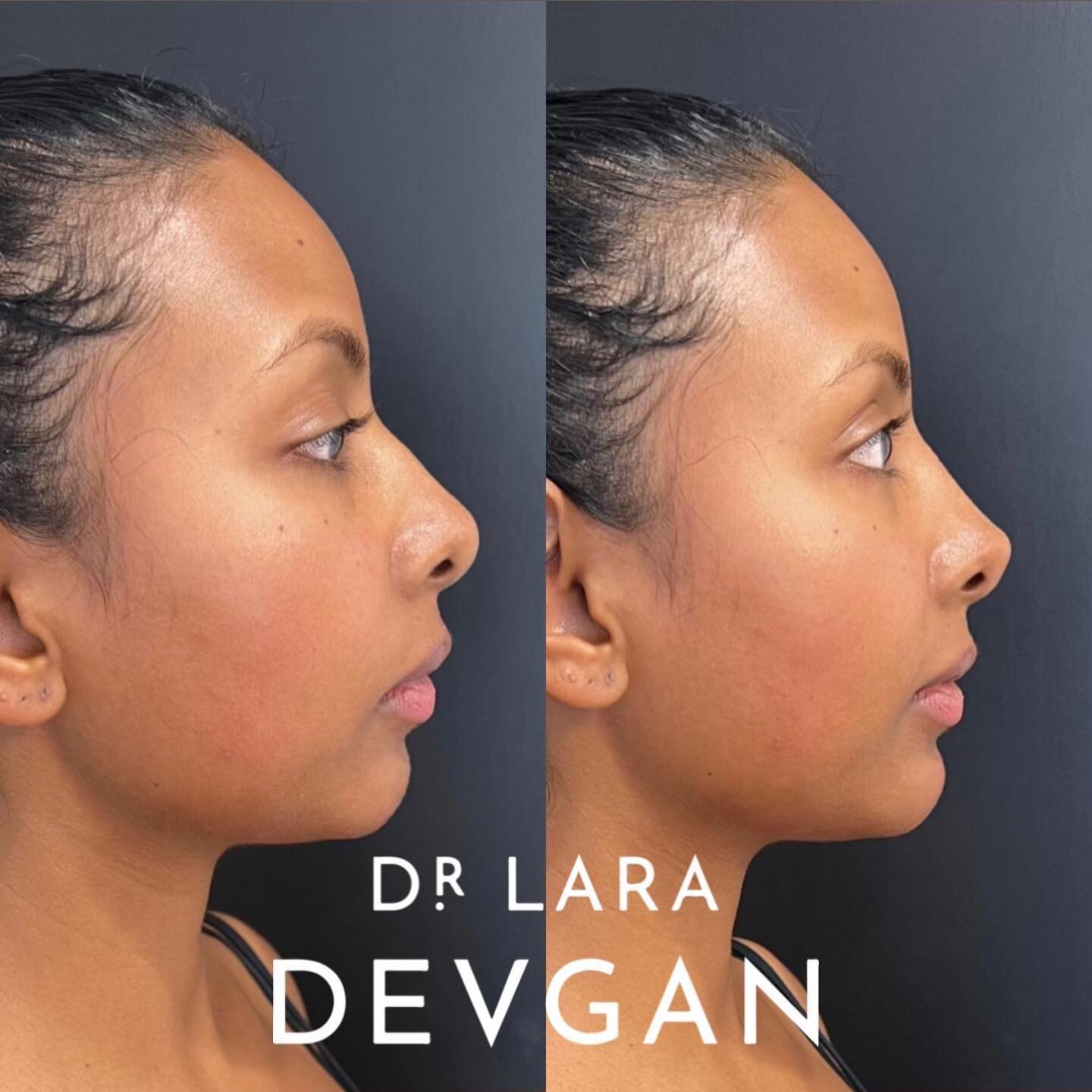
Doctor's Notes | We Are Living in the Golden Era of Plastic Surgery

In this TikTok, Dr. Devgan gives her thoughts on what it means to be living in the golden age of plastic surgery.


We Are Living in the Golden Era of Plastic Surgery

For most of modern history, plastic surgery was reactive.

It was about fixing what was broken—repairing trauma, reconstructing after illness, or reversing the visible effects of aging once they had already taken hold. The tools were limited, the techniques were evolving, and the outcomes, while often transformative, were not always predictable.

Today, that paradigm has fundamentally changed.

According to Dr. Lara Devgan, we are now living in the golden era of plastic surgery—a moment in time where scientific advancement, artistic precision, and patient empowerment have converged in a way that has never existed before.

Technology Has Changed Everything

One of the defining features of this golden era is technology.

Advancements in surgical techniques, imaging systems, laser technology, and regenerative medicine have dramatically improved both safety and results. Surgeons today have access to tools that allow for extraordinary precision, from ultra-refined suturing methods to minimally invasive treatments that can deliver meaningful improvements without extensive downtime.

Three-dimensional imaging allows surgeons and patients to visualize potential outcomes before a procedure ever begins. Energy-based devices and advanced injectables allow practitioners to refine facial contours and skin quality with remarkable accuracy.

What once required major surgery can now sometimes be achieved with subtle, strategic treatments.

This level of precision simply did not exist even fifteen years ago.

Natural Results Are the New Standard

Another hallmark of the golden era is the shift toward natural aesthetics.

In earlier decades, cosmetic procedures sometimes carried a recognizable “look.” Overfilled lips, overly tight facelifts, or exaggerated features became cultural stereotypes of plastic surgery.

That philosophy has largely been replaced by something far more sophisticated: enhancement that is virtually undetectable.

Today’s best work does not announce itself. Instead, it restores balance, proportion, and vitality while preserving what makes each face unique.

The goal is not transformation into someone else.
The goal is refinement of the best version of yourself.

This evolution reflects a deeper understanding of facial anatomy, aging patterns, and aesthetic harmony.

Prevention Is the New Philosophy

Perhaps the biggest shift in plastic surgery today is the move toward prevention.

Patients are no longer waiting until dramatic aging changes occur. Instead, many are choosing earlier, smaller interventions that help maintain youthful features over time.

Subtle neuromodulator treatments can soften lines before they become etched. Advanced skincare can stimulate collagen production. Precision injectables can support facial structure long before significant volume loss occurs.

In other words, modern aesthetics is increasingly about maintenance rather than correction.

This proactive approach allows results to look more natural because the changes happen gradually.

Patients Are More Informed Than Ever

The modern patient is also dramatically more informed.

Access to education, research, and consultation tools means that people approach aesthetic decisions with far greater knowledge and intention. Patients today understand the value of expertise, safety, and individualized care.

This shift has raised the overall standard of the field.

Patients expect more thoughtful consultations, more personalized treatment plans, and outcomes that align with their individual identity rather than generic beauty standards.

The Fusion of Science and Art

Plastic surgery has always required both technical mastery and artistic vision. But in this golden era, that balance has become even more important.

The surgeon must understand not only anatomy and surgical technique, but also proportion, symmetry, and aesthetic nuance. Small adjustments can dramatically influence how a face is perceived.

The difference between good work and exceptional work often lies in millimeters.

The best surgeons approach the face as a living sculpture—one that must retain movement, personality, and individuality.

The Future Is Even More Exciting

If the present moment represents the golden era, the future may be even more remarkable.

Regenerative medicine, stem cell research, next-generation biomaterials, and AI-assisted diagnostics are already beginning to reshape what is possible. Treatments that stimulate the body’s own healing and rebuilding processes may redefine how we think about aging entirely.

Rather than simply altering structure, the next frontier may focus on restoring the biological health of skin and tissue at a cellular level.

That is a profound shift.

A Transformational Moment in Aesthetic Medicine

Plastic surgery today is safer, more precise, more natural, and more personalized than at any point in history.

For patients, this means greater control over how they age and how they present themselves to the world. For surgeons, it represents an extraordinary moment of possibility—where innovation and artistry can come together to deliver results that once seemed unimaginable.

This is why many leaders in the field, including Dr. Lara Devgan, believe we are truly living in the golden era of plastic surgery.

And in many ways, we are only just getting started.


Appointment Inquiries

For inquiries and appointments, please email appointments at appointments@laradevganmd.com or call 212-452-2400. You may also use the following button to schedule an appointment online. We look forward to hearing from you. Thank you!

Doctor's Notes | Why I Prefer Hyaluronic Acid Fillers Over Sculptra

In this TikTok, Dr. Lara Devgan gives a summary of her day full of facial optimization work.


Why I Prefer Hyaluronic Acid Fillers Over Sculptra

As a plastic surgeon who divides my time between the operating room and nonsurgical treatments, my approach to injectables is grounded in precision, control, and predictability. While both hyaluronic acid fillers and Sculptra have their place, I find myself consistently favoring hyaluronic acid–based fillers in the majority of cases.

The primary reason is control. Hyaluronic acid fillers allow for immediate, visible results. I can shape, contour, and refine in real time—adjusting placement and volume with a high degree of accuracy. This is especially important in the face, where millimeters matter and subtlety defines a beautiful outcome.

Equally important is reversibility. Hyaluronic acid fillers can be dissolved if needed, offering a level of safety and flexibility that is unmatched. In a field where anatomy varies and patient preferences evolve, that ability to course-correct is invaluable.

In contrast, Sculptra works by stimulating collagen production over time. While this can be beneficial in select cases, the results are less immediate and less predictable. You are guiding a biologic response rather than placing structure directly—and once it’s done, it cannot be reversed in the same way.

From an aesthetic standpoint, I also prefer the precision of hyaluronic acid for sculpting. Whether refining the jawline, restoring midface volume, or softening lines, it allows for a level of definition and nuance that aligns with my overall philosophy: results that are natural, balanced, and never overdone.

Ultimately, it’s not about one product being “better” than another—it’s about choosing the right tool for the right patient. But when it comes to achieving refined, controlled, and elegant results, hyaluronic acid fillers remain my go-to.