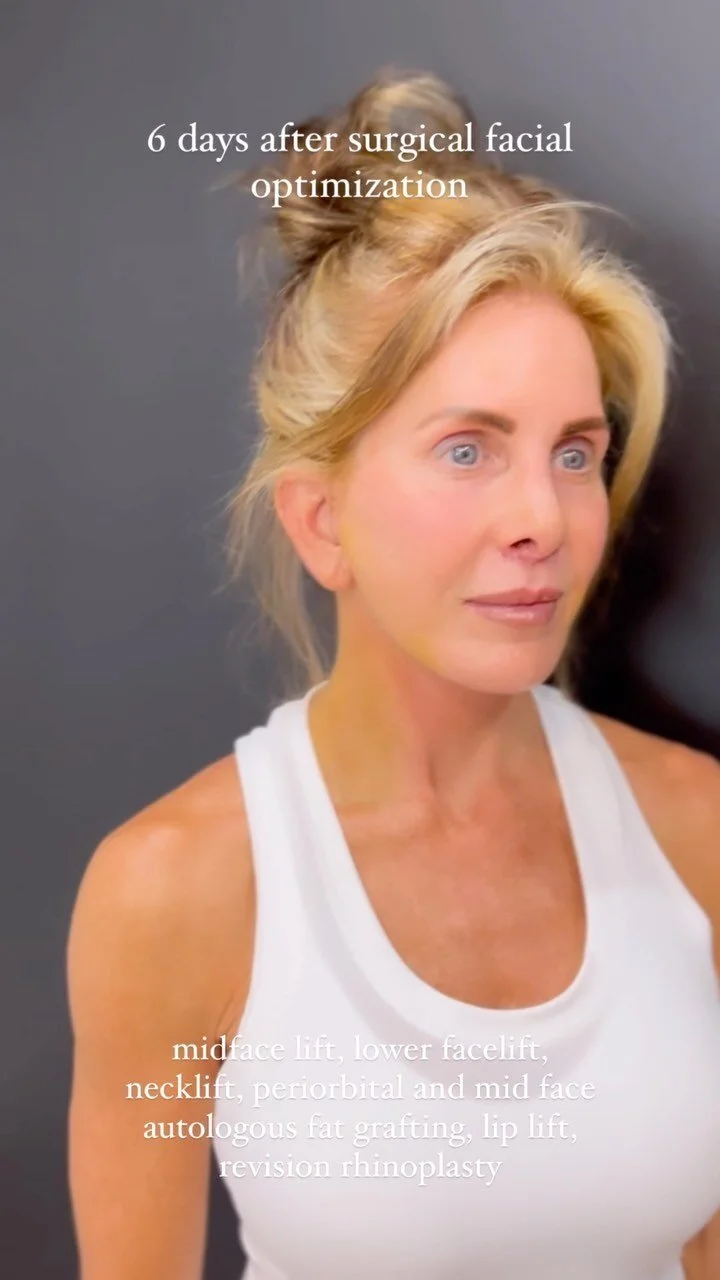
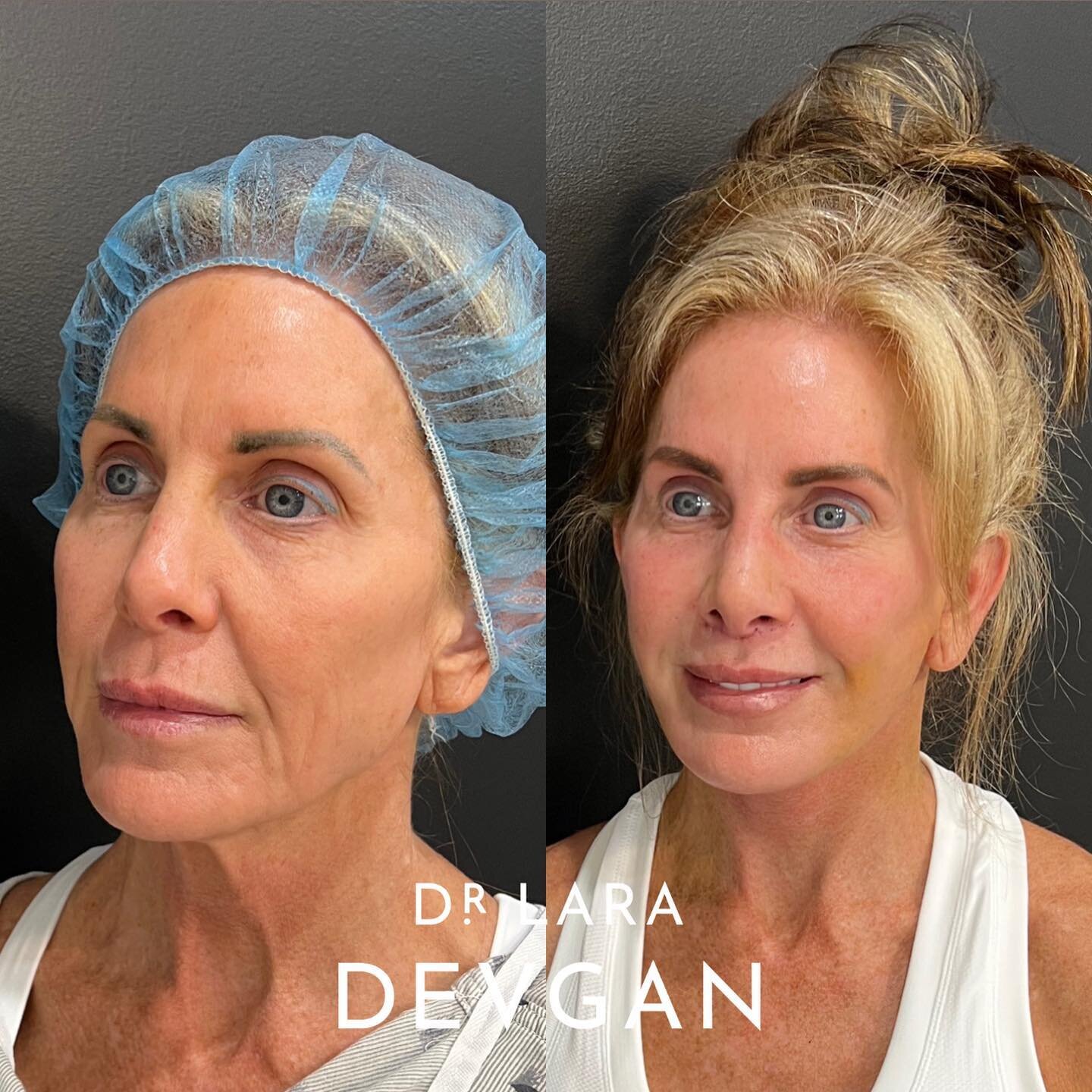
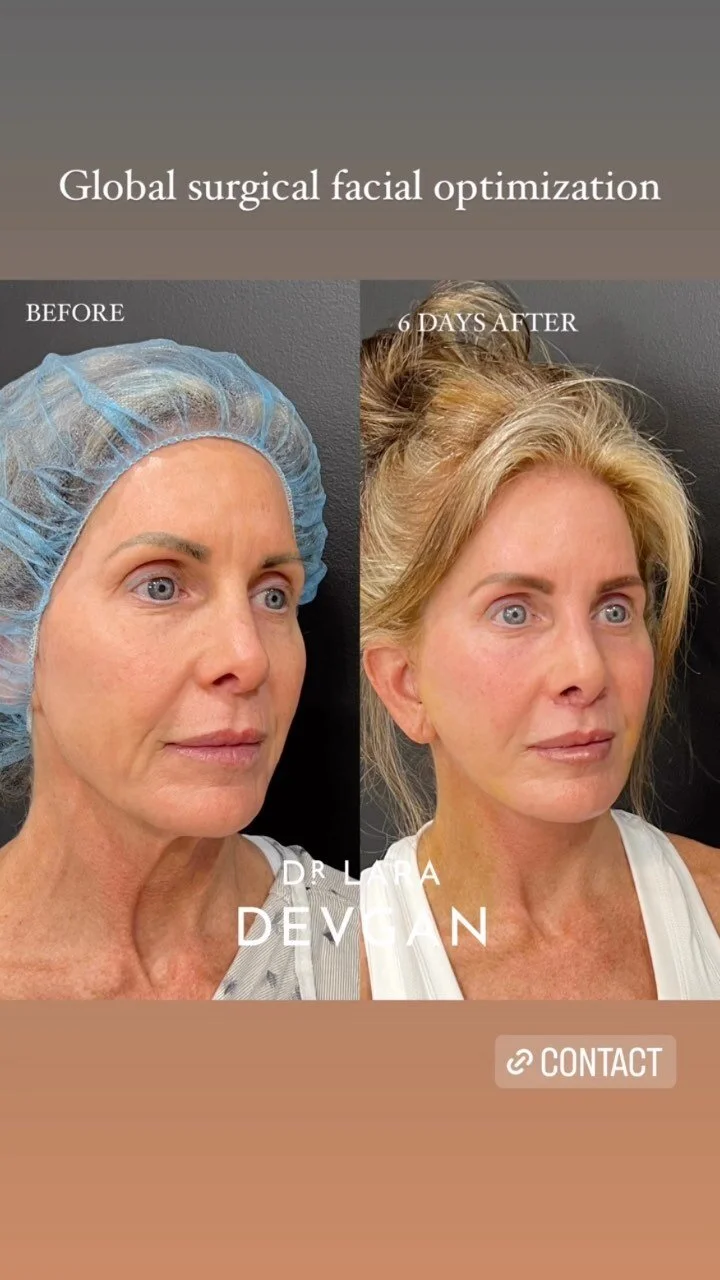
Signature Procedure | Blepharoplasty (Eyelid Surgery)

NYC Blepharoplasty Plastic Surgery

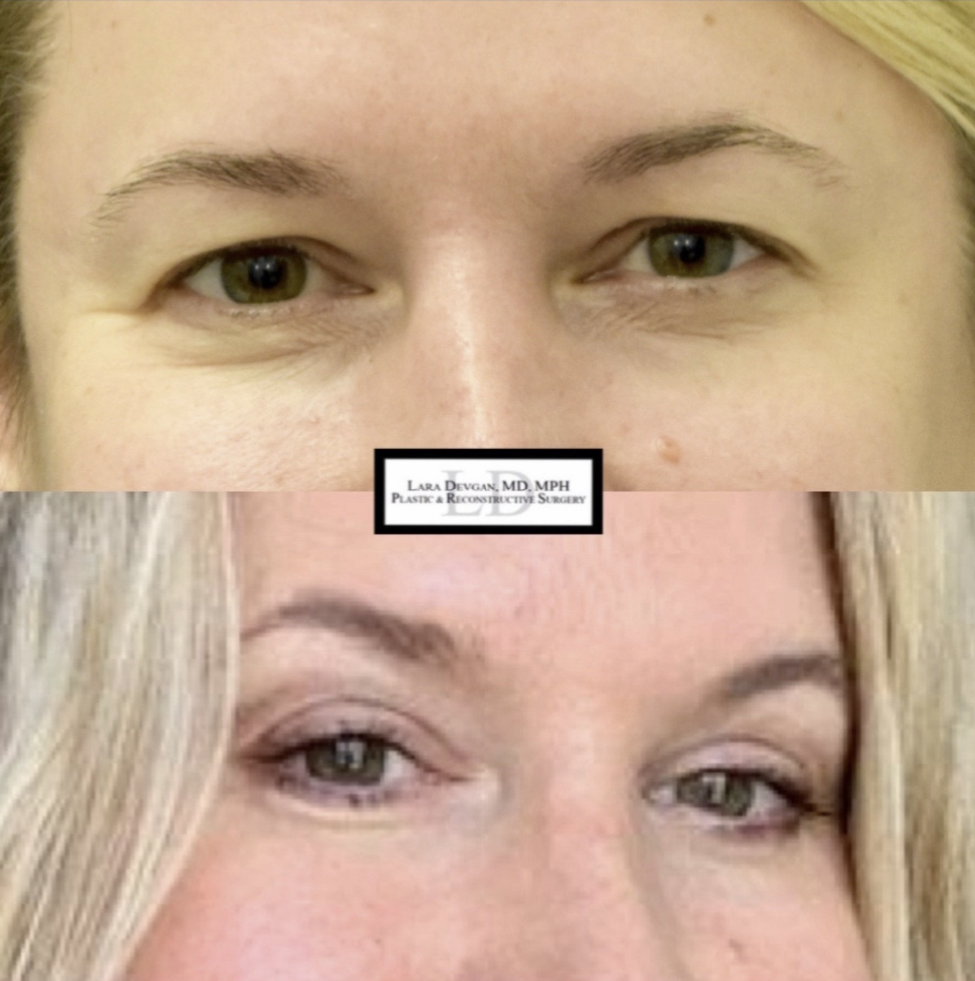
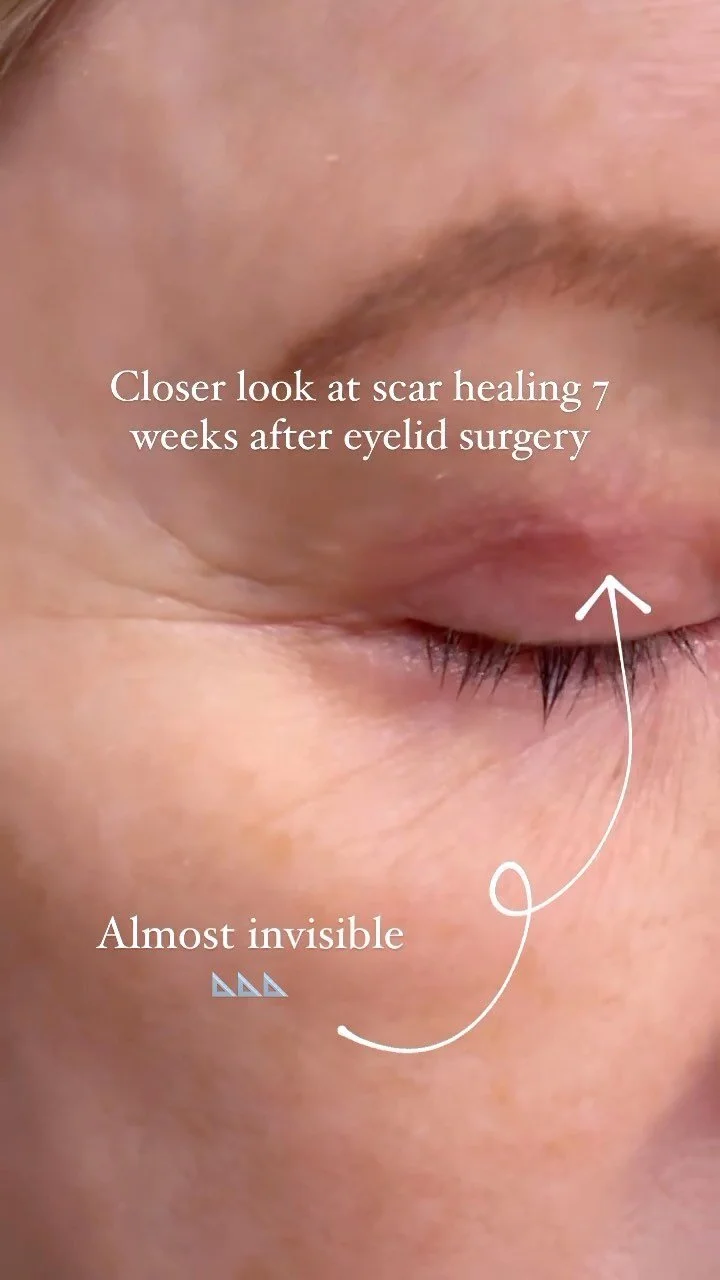
Dr. Lara Devgan’s Signature Blepharoplasty Procedure: Before & After


The Art of Eyelid Surgery: A Subtle Yet Powerful Transformation

Eyelid surgery, or blepharoplasty, is one of the most refined and elegant procedures in aesthetic enhancement. Unlike more dramatic facial surgeries, it doesn’t seek to alter the fundamental character of the face. Instead, it optimizes the delicate details that frame the eyes, creating a refreshed and harmonious appearance.

The eyes are often called the windows to the soul, and even the slightest adjustment to the eyelids can make a remarkable difference. Smoothing excess skin, refining the contour of the upper eyelid, or subtly addressing under-eye puffiness allows more light to reach the eyes. This makes them appear brighter, more open, and more expressive—without looking “done.”

The beauty of eyelid surgery lies in its subtlety. A well-performed blepharoplasty doesn’t announce itself; instead, it enhances in a way that feels completely natural. Others may not be able to pinpoint exactly what has changed, but they will notice a refreshed and well-rested look. The goal is not to create a different face but to reveal a more youthful, vibrant version of yourself.

Additionally, eyelid surgery is not just about aesthetics—it can also have functional benefits. Excess skin on the upper eyelids can sometimes impair vision, making the procedure both a cosmetic and practical improvement. Whether performed alone or in combination with other treatments, such as brow lifts or skin resurfacing, blepharoplasty remains one of the most effective ways to rejuvenate the eyes.

When done with precision and artistry, eyelid surgery enhances natural beauty while preserving individuality. It allows the eyes—the true focal point of the face—to shine with clarity, warmth, and expression.


Appointment Inquiries

For inquiries and appointments, please email appointments at appointments@laradevganmd.com or call 212-452-2400. You may also use the following button to schedule an appointment online. We look forward to hearing from you. Thank you!

SUBSTACK: 6 Overhyped Aesthetic Treatments You Should Not Try (No Matter What Your Favorite Influencer Says)

In this TikTok, Dr. Devgan breaks down the 6 Overhyped Aesthetic Treatments You Should Not Try (No Matter What Your Favorite Influencer Says) from her latest Substack hit.


6 Overhyped Aesthetic Treatments You Should Not Try (No Matter What Your Favorite Influencer Says)

Aesthetic medicine has entered a strange new era: treatments go viral before they’re proven. A single Instagram reel can create demand faster than years of clinical study. Suddenly everyone is an expert on collagen stimulation, “regenerative injectables,” skin boosters, and “biohacking” the face.

And the marketing is almost always the same: natural, effortless, no downtime, science-backed, better than filler, better than surgery.

Here’s the truth: science does not care about aesthetics marketing. Your face is not a trend canvas. And “popular” is not the same as safe, effective, or predictable.

Innovation matters — but it has to be real innovation. The gold standard isn’t what looks good on camera. It’s what works in real human faces long-term, with controlled technique, reproducible outcomes, and known complication profiles.

Below are six treatments being heavily promoted right now that I consider massively overhyped — and in some cases, simply not worth the risk.

1) Salmon Sperm Facials (“Salmon DNA” / “Salmon Skin” injections)

This trend is designed to go viral. The name is intentionally provocative, and the implication is seductive: if it’s derived from something “biologic,” it must be regenerative, restorative, and better than traditional injectables.

But medicine doesn’t work that way.

“Natural” is not a safety category. Biologic does not automatically mean effective. And a treatment being trendy does not mean it’s supported by high-quality long-term data.

The bigger issue is this: the average patient has no idea what they’re actually getting.

You’ll see vague language about “DNA fragments,” “cell signaling,” and “repair.” But what matters in practice is far more specific: product purity, sterility, manufacturing oversight, dosing, injection depth, patient selection, and how it behaves over time in living tissue.

If a treatment needs shock value to sell itself, that should immediately raise suspicion. Truly high-performing aesthetic treatments don’t need gimmicks.

2) PBM / “PBRM” (Photobiomodulation / red light-style devices)

Let’s be clear: photobiomodulation is not nonsense. Light-based therapies can have real benefits in medicine — especially in wound healing and inflammation reduction.

But the current aesthetic PBM trend has become absurdly inflated.

Social media has turned red-light devices into a kind of skincare religion: “Fixes collagen,” “reverses aging,” “erases wrinkles,” “tightens skin,” “rebuilds the dermis.”

That’s not reality.

At best, PBM is a supportive tool. It may reduce inflammation, improve recovery, or give mild improvements in skin tone and redness for the right person. But it is not a facelift. It is not a substitute for eyelid surgery. And it will not meaningfully correct laxity, deep wrinkles, or structural aging.

If you want a simple filter: if a treatment would need to create dramatic change to justify the hype — and it doesn’t — then it’s overhyped.

PBM is fine. The marketing is not.

3) PRF (Platelet-Rich Fibrin)

PRF is one of the most misunderstood treatments in aesthetics because it sits in a gray zone between “legit biologic approach” and “social media miracle.”

Yes: PRF is autologous (comes from your blood). Yes: it can have regenerative properties. Yes: it may have a role in improving texture and supporting the under-eye area in select patients.

But here’s what’s missing from the conversation online: PRF outcomes are wildly variable.

Why?

Because results depend on:

  • the patient’s baseline biology

  • the preparation method

  • centrifuge settings

  • platelet concentration

  • injection technique

  • depth of placement

  • and very importantly: the patient’s anatomy and degree of volume loss

PRF is often pitched as “filler without filler” — as if it can replace structural volume or surgical correction.

It cannot.

If someone has significant under-eye hollowing, skin laxity, or herniated fat pads, PRF will not deliver the kind of transformation they’ve been promised. And repeated sessions chasing a result can become expensive, frustrating, and still underwhelming.

PRF can be a nice adjunct. It is not magic. And it is frequently oversold.

4) Easy Gel

This one falls into a category I call aesthetic improvisation: treatments that sound convenient, trend fast, and have nowhere near the long-term safety track record required for faces.

Easy Gel is often framed as a “natural filler alternative,” or a “better, safer option,” typically bundled with vague claims about regenerative effects.

Here’s the problem: the face is not a place for casual experimentation.

Anything injected must be evaluated by:

  • biocompatibility

  • inflammatory potential

  • migration risk

  • reversibility (or lack thereof)

  • longevity and breakdown behavior

  • risk of nodules, granulomas, irregularity

  • interaction with future surgeries, lasers, and fillers

The truth is that the “easy” part is marketing. There is nothing easy about complications from unknown gels or poorly characterized injectable materials.

Predictability is luxury in aesthetics. If the material is not predictable, it’s not a luxury treatment — it’s a liability.

5) Heat-Based Energy Devices on the Face

This includes the entire world of heat-based tightening treatments — radiofrequency, ultrasound, and energy devices marketed for lifting, tightening, and collagen stimulation.

Yes, energy devices can work. Yes, they have a place.

But the way they’re being used now is often aggressive, repetitive, and misguided — especially for younger patients, lean faces, or anyone vulnerable to volume loss.

Here’s what patients aren’t told enough:

Heat does not only tighten skin. Heat can also damage fat.

When facial fat is compromised, the result is not “snatched.” It’s hollow, harsh, and prematurely aged — especially around the temples, cheeks, and perioral area.

Once you lose volume in the face, you don’t look younger. You look older.

And no, the answer is not always “just add filler.” Replacing natural fat loss is possible, but it’s not as simple as reversing a mistake.

In the wrong patient, heat devices trade the glow of short-term tightening for long-term facial deflation. That trade is unacceptable.

6) Injected Peptides

Peptides have become the trendiest word in the biohacking-to-aesthetics pipeline.

They are marketed like futuristic medicine: “signals your body to regenerate,” “stimulates collagen,” “reverses aging,” “heals tissue,” “like stem cells but better.”

What’s usually missing: credible long-term data, safety oversight, and transparency.

A peptide may be effective in a lab setting. That does not mean it is safe or appropriate to inject into human faces — especially outside a robust regulatory framework.

The injection trend is being driven by internet culture, not clinical standards.

And injected peptides introduce a massive risk-to-reward mismatch:

  • unknown dosing and formulation standards

  • unknown contamination risk

  • unpredictable immune response

  • unknown long-term tissue behavior

  • no reliable reversal mechanism if something goes wrong

The face is not the place for experimental wellness culture.

If something goes wrong, you don’t “detox.” You end up managing an inflammatory complication in the most delicate tissue on the body — and that’s not something anyone should gamble on.

The Big Idea: Choose Predictability Over Hype

Most patients don’t want “the newest thing.”

They want:

  • to look rested

  • to look brighter

  • to look like themselves

  • to avoid obvious work

  • and to make smart, safe choices

The best aesthetic outcomes are built on fundamentals:

  • anatomy

  • restraint

  • meticulous technique

  • proven tools

  • and a long-term plan

If a treatment feels like it’s being sold through internet excitement rather than real clinical rigor, trust your instincts.

Your face deserves predictability — not hype.

Appointment Inquiries

For inquiries and appointments, please email appointments at appointments@laradevganmd.com or call 212-452-2400. You may also use the following button to schedule an appointment online. We look forward to hearing from you. Thank you!

Signature Procedure | Upper and Lower Eyelid Blepharoplasty


Finesse Eyelid Surgery: Bright, Rested Eyes—Without Looking “Done”

The eyes are often the first place the face shows fatigue. Not always aging in a dramatic way—sometimes simply in subtle heaviness, shadowing, puffiness, or a loss of crisp definition that makes you look more tired than you feel.

But eyelid rejuvenation should never be about changing someone’s face. It should be about restoring it.

That’s the philosophy behind finesse eyelid surgery: a highly tailored approach to upper and lower eyelid refinement designed to refresh the eye area while preserving identity, shape, and natural expression.

This is not “more surgery.” It’s smarter, more meticulous surgery—done with restraint, artistry, and a deep respect for what makes a face recognizable.

What Makes Eyelid Surgery Look Natural (or Not)

The difference between excellent eyelid surgery and obvious eyelid surgery usually comes down to one thing: overcorrection.

When too much skin is removed, or too much volume is taken away, the result can look hollow, tight, or strangely unfamiliar. The eyes may appear rounder, more exposed, or harsh—often described as “overdone,” even when the goal was simply to look rested.

Finesse eyelid surgery is built to prevent that outcome from the start. Every technique is chosen conservatively and customized precisely to the anatomy of the patient’s eyes—because the eye area is not a place for aggressive changes.

Upper Eyelid Refinement: Elegant, Clean, Youthful Definition

In the upper lid, the goal is refinement—not transformation.

With a carefully performed upper blepharoplasty, excess skin is reduced and subtle fullness is refined using meticulous incision placement. The intention is to preserve a natural-looking lid crease and maintain smooth, youthful contours.

Done correctly, the result is a clean, bright upper eyelid that still looks like you—not “surgically improved.”

Critically, finesse techniques avoid the hollowed-out look that can happen when volume is removed too aggressively. Instead of subtracting too much, the approach focuses on balance: enough correction to restore a rested appearance while maintaining natural softness.

Lower Eyelid Surgery: Smooth the Contour, Preserve Support

Lower eyelid aging can show up as puffiness, shadowing, or an uneven transition from eyelid to cheek. This is where less-experienced techniques can go wrong: pull the skin too tight or disrupt lid support, and the eye can look unnatural or “operated on.”

Finesse lower blepharoplasty focuses on smoothing the under-eye contour while protecting lid integrity and support.

Rather than simply removing tissue, this technique aims for a seamless transition from the eyelid into the cheek—so the under-eye looks smooth, rested, and continuous, not hollow or sharply divided.

The objective is not a “flat” under-eye. It’s a healthy, youthful one.

When Needed: A Conservative Temporal Brow Lift to Restore the Frame

Sometimes the issue isn’t only the eyelid—it’s the architecture above it.

The outer portion of the brow can gradually descend, creating heaviness at the outer upper lid and changing the eye’s overall “frame.” In these cases, a conservative temporal brow lift can be the missing piece.

This is not the dramatic brow lift many people worry about. Finesse technique uses gentle elevation of the outer brow to open the eye and restore the upper face’s youthful framing—without changing signature features.

The goal is subtle lift, not surprise.

Strategic Fat Grafting: Natural Volume, Softer Shadows, Better Skin Quality

One of the most overlooked aspects of eye aging is volume loss.

Shadowing around the orbit—especially at the lid-cheek junction—often isn’t due to excess skin. It’s due to diminished support and soft tissue padding, which changes the way light reflects in the area.

Autologous fat grafting (using the patient’s own fat) can be used strategically to replenish this soft volume loss. In the right hands, fat grafting around the orbit can:

  • reduce hollowing and harsh shadowing

  • restore smoothness and softness

  • enhance overall skin quality

  • create a natural, long-lasting finish

It’s not about adding “fullness.” It’s about restoring the light and softness that makes the eye area look youthful.

The Result: Effortless Rejuvenation That Preserves Identity

The true hallmark of finesse eyelid surgery is that it doesn’t announce itself.

You don’t look like you “had your eyelids done.” You look brighter. Cleaner. More awake. Like you’ve been sleeping well, drinking water, and living a better life than you actually have.

It’s refined, balanced rejuvenation—never obvious, never exaggerated, and never at the expense of natural expression.

Because the best aesthetic work doesn’t change who you are.

It simply restores you.


Appointment Inquiries

For inquiries and appointments, please email appointments at appointments@laradevganmd.com or call 212-452-2400. You may also use the following button to schedule an appointment online. We look forward to hearing from you. Thank you!

Doctor's Notes | The Key Features of Breast Augmentation

In this TikTok, Dr. Devgan breaks down the key features of her Signature Breast Augmentation Procedure.


Breast Augmentation: The Art of Proportion, Balance, and Timeless Shape

Breast augmentation is often discussed in terms of size—“how big,” “what cup,” or “how much volume.” But the truth is that the most beautiful breast augmentation results have very little to do with volume alone.

At its highest level, breast augmentation is a study in proportion, shape, balance, and harmony. It’s about designing an outcome that looks naturally elegant on the specific frame in front of me—never overpowering, never artificial, and never trending into something that reads as obviously “done.”

Breast Augmentation Is Not About Volume—It’s About Fit

A refined augmentation begins with one essential question:

What looks right on this body?

That answer is rooted in anatomy—not in a number on a sizing chart.

A thoughtful augmentation respects the patient’s natural foundation, including:

  • Chest wall anatomy

  • Ribcage shape

  • Shoulder width

  • Torso length

  • Breast base width

  • Existing breast footprint and skin characteristics

Implants should never be selected based on “preference” alone. The most important factor is ensuring that implant dimensions match the patient’s base width, so the breast footprint remains natural and proportional to the chest wall.

When the implant fits the frame, the result looks effortless.

When the implant overpowers the frame, the result looks engineered.

Shape Matters as Much as Size

What patients often describe as “natural” is rarely about being small—it’s about being balanced.

In reality, a breast’s aesthetic beauty is driven by shape details, including:

  • The slope of the upper pole

  • The softness and fullness of the lower pole

  • The position of maximal projection

  • The way the breast transitions into the décolletage

A well-designed augmentation creates a silhouette that feels smooth, proportional, and feminine—not overly round, overly high, or exaggerated.

This is where experience truly shows. Two patients can receive implants with similar volume, but end up with completely different outcomes depending on shape planning and anatomical nuance.

Harmony Is a Full-Body Concept

Breasts don’t exist in isolation.

To look naturally beautiful, the breasts must integrate into the overall architecture of the body—particularly how they relate to:

  • The shoulders

  • The ribcage

  • The waist

  • The hips

  • The overall torso length

True elegance is achieved when the breasts complement the body’s proportions rather than dominating them.

The goal is never to “win the room” with volume.

The goal is to enhance femininity and presence in a way that feels seamless and authentic.

Symmetry, Movement, and Natural Behavior

Beauty isn’t static. It’s dynamic.

A successful breast augmentation doesn’t just look good in a mirror—it looks good in motion. That means:

  • The breasts sit symmetrically

  • They move naturally

  • They feel proportionate and stable on the chest wall

  • The silhouette looks elegant from multiple angles—not only head-on

This is especially important because the eye detects imbalance instantly. A refined augmentation accounts for symmetry not only in size, but in position, slope, and overall shape.

A Result That Enhances Identity—Not Replaces It

The best breast augmentations elevate confidence without erasing individuality.

When augmentation is performed thoughtfully, it enhances:

  • femininity

  • softness

  • proportion

  • elegance

…but still feels aligned with the patient’s identity.

That’s the difference between a good augmentation and a truly exceptional one.

The ideal outcome is not dramatic. It is refined—an improvement that feels so natural it looks like it could have always been there.

The Goal: Timeless, Balanced, Beautiful

Breast augmentation should never be one-size-fits-all.

It should be personalized, anatomy-driven, and executed with a focus on shape design and long-term harmony, not temporary trends.

When done at the highest level, breast augmentation is not about looking augmented.

It’s about looking proportional, elegant, and effortlessly feminine—from every angle.


Appointment Inquiries

For inquiries and appointments, please email appointments at appointments@laradevganmd.com or call 212-452-2400. You may also use the following button to schedule an appointment online. We look forward to hearing from you. Thank you!

Doctor's Notes | The Intricacies of the Lip Lift

In this TikTok, Dr. Devgan breaks down the intricacies of her Signature Lip Lift/Lip Augmentation Procedure.


The Intricacies of the Lip Lift

There are certain facial refinements that feel quietly transformative—procedures that don’t announce themselves, but instead restore something you didn’t realize had changed. A well-executed lip lift is one of the best examples of that.

It is a precise, high-impact procedure designed to reduce an elongated philtral distance, restore youthful upper lip proportion, and improve tooth show in a way that reads natural rather than “done.” When performed thoughtfully, a lip lift doesn’t change who you are—it simply brings the upper lip back into harmony with the rest of the face.

Why the Upper Lip Changes Over Time

A common misconception is that lips only age by losing volume. In reality, one of the most important—and often overlooked—changes is lengthening of the philtrum, the vertical space between the base of the nose and the upper lip (vermilion border).

Over time, this distance can elongate subtly, causing the upper lip to appear:

  • thinner (even if volume is technically still present),

  • flatter and less defined,

  • less projected,

  • less expressive,

  • and “heavier” or more aged in the midface.

The result is not necessarily an unattractive face—often it’s simply a face that looks less fresh, less feminine, and less balanced than it once did.

What a Lip Lift Actually Does

A lip lift restores proportion by shortening the space between the base of the nose and the upper lip, which can:

  • re-establish a more youthful upper lip-to-midface relationship

  • increase upper tooth show in a natural way

  • enhance Cupid’s bow definition and upper lip shape

  • improve lip “presence” without adding filler

  • bring lightness and femininity back to the lower midface

This is why lip lifts often photograph so beautifully when done correctly—because they impact facial balance, not just lip size.

The “Natural” Lip Lift: What That Really Means

The most important principle I emphasize is this:

A lip lift should never look like a lip lift.

Patients should not look over-lifted, exaggerated, overly toothy, or as though the mouth has been pulled upward. The goal is a result that appears effortless and timeless, as though your facial proportions were simply always meant to look this way.

A lip lift is not about drama. It’s about refinement.

My Signature Approach: Conservative, Anatomy-Driven, and Scar-Centered

A lip lift may look small in scope, but it is deceptively intricate. Millimeters matter. Symmetry matters. And scar quality matters—immensely.

My approach is:

  • conservative and anatomy-driven, never aggressive

  • centered on scar quality and long-term elegance

  • designed to preserve natural proportion, softness, and expression

This is not a procedure where “more lift” means “better result.” In fact, excessive lifting is one of the quickest routes to an unnatural outcome.

Scar Strategy Is Everything

One of the most important technical aspects of a lip lift is how the incision is designed and how it heals.

The ideal incision plan:

  • hides within natural shadows,

  • respects the contours of the base of the nose,

  • avoids conspicuous external markings,

  • and heals so discreetly that it does not distract from the result.

The scar should never be the headline. The entire point is for the lip to look beautiful—without anyone noticing the surgical work behind it.

Two Techniques: Scarless Internal vs. External Precision

Not every face needs the same approach. Patient selection determines everything.

1) Scarless Internal Lip Lift (in carefully selected patients)

For the right candidate, an internal technique may offer meaningful refinement without an external scar. This approach can be ideal for patients who need a subtle adjustment and have favorable anatomy.

2) Meticulous Transcolumellar-Only Lip Lift (when external is needed)

When an external approach is necessary, I favor a highly refined transcolumellar-only technique—a strategy that prioritizes discretion and minimizes visible scarring.

This is not about “just removing skin.” It is about:

  • incision placement,

  • tension control,

  • symmetry management,

  • and sculpting the lift so it looks elegant rather than surgical.

What Makes a Lip Lift Look “Done” (and How We Avoid It)

The most common mistakes happen when the procedure is treated as a simple mechanical adjustment rather than an aesthetic operation.

Results can look unnatural when:

  • the lift is excessive,

  • the Cupid’s bow is distorted,

  • the nostrils or base of the nose are pulled unnaturally,

  • the incision is poorly planned,

  • or symmetry is not respected down to the millimeter.

My goal is always:

  • refined tooth show (not too much),

  • improved lip shape (not “pulled”),

  • better proportion (not a different face),

  • and a result that holds up beautifully long-term.

Who Is a Great Candidate?

A lip lift may be an exceptional option for patients who:

  • feel the upper lip looks long or “aged”

  • want more tooth show and lip definition without volume

  • have tried filler but still feel the upper lip looks heavy or stretched

  • want a structural improvement rather than temporary camouflage

For many patients, the lip lift is the missing piece—because it restores architecture, not just fullness.

The Bottom Line

A lip lift is not a trend-driven procedure. When done properly, it is one of the most elegant and proportion-restoring operations in facial aesthetics.

It is a precise enhancement designed to re-balance the relationship between the midface and mouth, subtly restoring femininity, freshness, and facial harmony.

My philosophy remains the same:
conservative, anatomy-driven refinement, meticulous attention to symmetry and Cupid’s bow definition, and an incision strategy designed to heal discreetly within natural shadows.

The goal is never to look “done.”
The goal is to look like yourself—only more proportionate, refreshed, and timeless.


Appointment Inquiries

For inquiries and appointments, please email appointments at appointments@laradevganmd.com or call 212-452-2400. You may also use the following button to schedule an appointment online. We look forward to hearing from you. Thank you!