Retinol: What it is and why you should use it

Written by Jack Nicastro

retinol.jpg

Where did retinol come from?

A derivative of vitamin A, Retinol has been wildly popular since 1971 when Dr. Kligman, a dermatologist from the University of Pennsylvania, discovered that retinoic acid proved effective both in treating acne for young people and smoothing wrinkles for older folks.

What are its benefits and shortcomings?

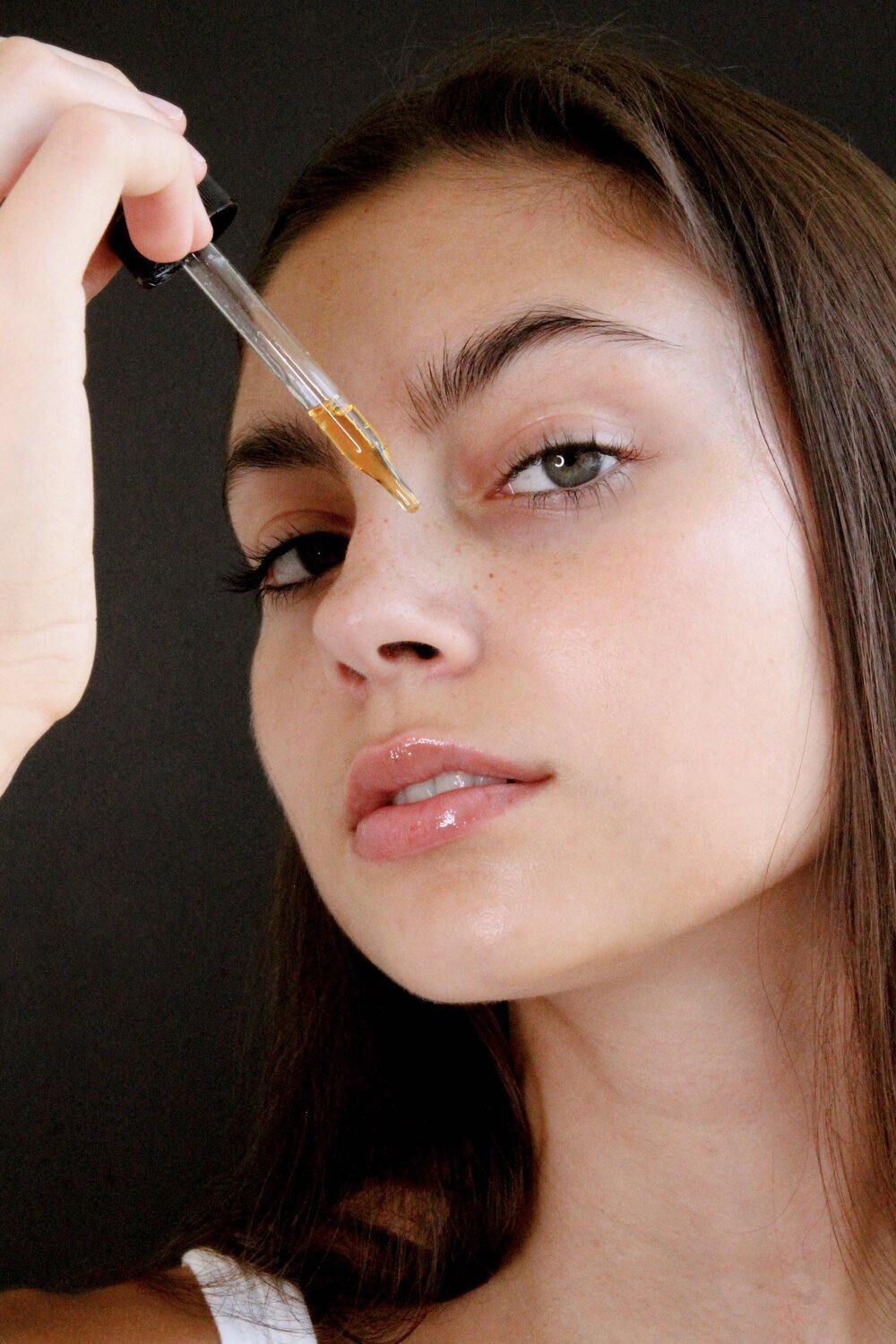
Retinol is a chemical precursor to retinoic acid and is metabolized by the skin cells as such when applied topically as a cream, oil or water-based solution. While extraordinarily effective in acne-fighting and wrinkle-smoothing, it has the potential to leave skin dried out and irritated depending on its concentration. 

Why is my skin peeling? 

It is not uncommon for sensitive skin to undergo a Retinoid Reaction, i.e. temporary  contact dermatitis. This harmless reaction (though uncomfortable) reaction is more likely to occur with higher concentrations of retinol. For this reason, we recommended applying our mild (2.5 times) concentration once every two to three days,  if you haven’t ever used a retinol-based product previously. Gradually approach daily use as your skin acclimates to the retinol.

What is the right concentration for me? 

Have you added anything to reduce the dryness caused by the retinol?

Yes! We recently added bakuchiol to our retinol serum as its anti-inflammatory, antioxidant and anti-bacterial properties help ameliorate the dryness and irritation caused by high concentrations of retinol.

Dr. Devgan featured in Who What Wear’s article: “The Best Youth-Enhancing Skin Regimens Include These 8 Strategic Ingredients”

Written by Jack Nicastro

whowhatwherelogo.jpg

Dr. Devgan offers her expert advice to explain to Who What Wear why you ought to incorporate hyaluronic acid and vitamin c into your skincare routine as well as why you should be staying away from creams claiming to vanish stretch marks, facial oils and large fragment facial scrubs.

 
hyaluronic serum.jpg

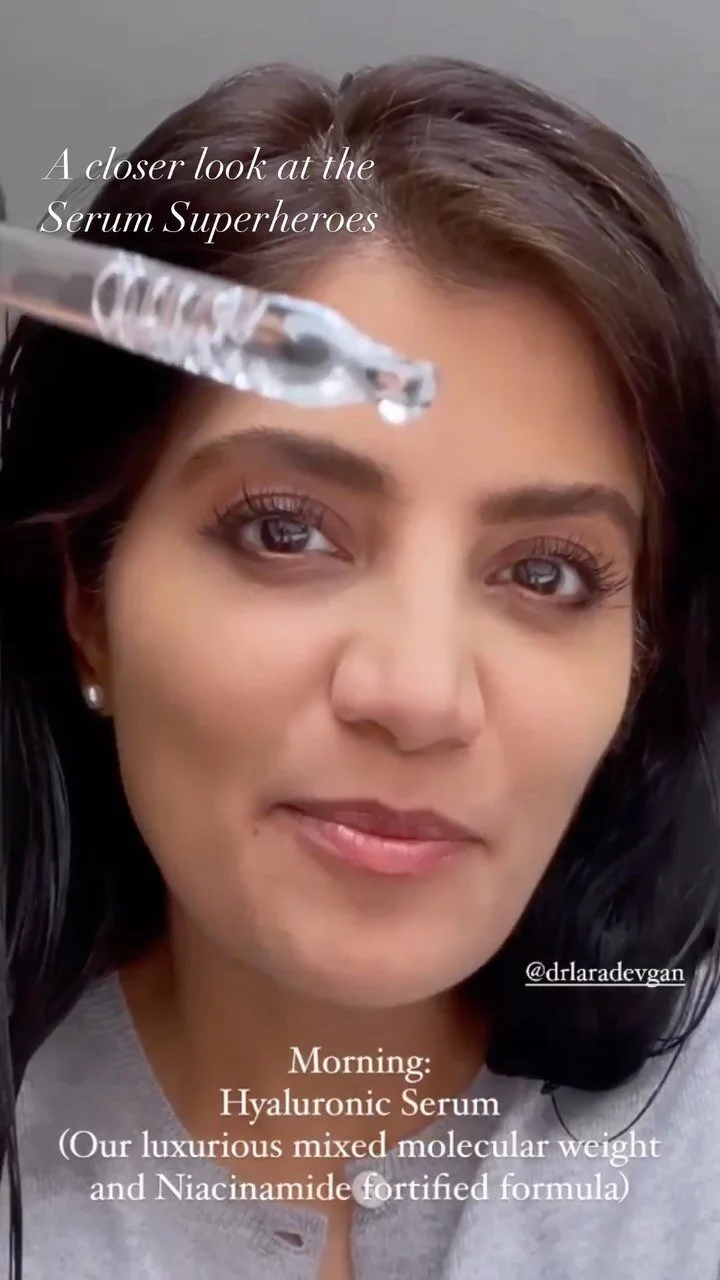
With all the hype surrounding it, Dr. Devgan’s confirms that hyaluronic acid does indeed produce glossy, glass-like skin: “it’s a major component of the body’s collagen, and it's a complex sugar molecule that can absorb 1000 times its weight in water.” Dr. Devgan’s mixed molecular weight Hyaluronic Serum possesses smaller fragments of hyaluronic acid which, as she states in the article, “more effectively penetrate into the dermis to hydrate from within while the larger fragments reside on top of the skin to create a beautiful finish."

 
vitamin c.jpg

The subject of a similar degree of hubbub, Dr. Devgan explains how antioxidant-rich vitamin c serums fade brown spots, reduces discoloration and fine lines by “scaveng[ing] free radical[s] and environmental damage that has compromised the skin.” Dr. Devgan’s own Vitamin C + B + E Ferulic Serum is available for those who want to achieve the kind of luminous skin one sees in beauty magazines.


Now that we’ve discussed what you should be using, it’s high-time we explain what you should not: there is no such thing as a stretch-mark clearing cream, so those that market themselves as such are frankly fraudulent; the molecules in facial oils are too large to penetrate the dermis to hydrate it from within and may result in clogged pores; large fragment facial scrubs regularly result in micro-tearing of healthy skin and chemical peels can result in irritation and dryness if executed poorly by an amateur.

A No-Nonsense Guide to Exfoliating

Written by Jack Nicastro

microdermabrasion scrub.jpeg

Chemical Exfoliation: the use of alpha hydroxy acids (AHA’s) and beta hydroxy acids (BHA’s) to break down the bonds adhering dead skin cells to healthy skin cells so that they can be washed off more easily. 

Physical Exfoliation: the technique of removing dead skin cells by using either a physical brush or a liquid with abrasive granules.

Why you Should Exfoliate: the capacity of epidermal stem cells to regenerate functional cells is an ability unique to the skin and can lead to layers of dead skin cells accumulating on top of healthy ones.

Benefits of Exfoliation: sloughing off dead skin cells to reveal the living ones beneath enhances the efficacy of your skin care products by making sure that the active ingredients reach the healthy dermis. For adolescents and others with skin predisposed to acne, exfoliation also serves to remove debris from pores which would otherwise lead to breakouts.

Reasons to Use Dr. Devgan’s Scientific Beauty Microdermabrasion Scrub:

  1. Dr. Devgan’s scrub is a physical exfoliant that uses tiny sugar granules to avoid micro-tearing of the skin while getting deep into pores to clear out acne-causing sebum.

  2. Physically evens out the skin’s texture by ameliorating scars and removing the outer layer of dead skin cells that build up unevenly across the face.

  3. Diminishes the appearance of dark spots resulting from acne and melasma. 

  4. Evens skin tone by reducing the presence of age spots. 

  5. Addresses dullness by brightening the skin.

Breaking Down Breakouts

Written by Jack Nicastro

One of the worst parts of being a young adult is having to deal with pimples, acne, blackheads and whiteheads due to overactive oil glands in the pores which can clog them with dead skin cells. Since the vast majority of teenagers experience these skin problems to one degree or another, a huge acne-fighting industry has sprung up to address the demand for solutions. The only problem with this is that there is a never-ending number of products to choose from and an inundation of information to parse through. That’s where Doctor Devgan comes in to recommend the five most effective ways to stop breakouts dead in their tracks.

acne_image.jpeg
  1. Benzoyl peroxide decreases the presence of P. acnes bacteria which, as the name suggests, is one of the principal culprits in causing acne breakouts. Dr. Devgan’s Acne Defense System includes the Acne Control Serum which uses fast-drying 5% benzoyl peroxide solution to kill this bacteria on contact.

  2. Glycolic acid reduces the presence of sebum (a.k.a. dead skin cells) in pores which would otherwise create a skin environment conducive to bacteria proliferation. Dr. Devgan’s Acne Control Serum also includes this acid as an active ingredient at 5% concentration. 

  3. Retinoids function similarly to glycolic acid to unclog pores by reducing the oiliness. Dr. Devgan’s new Retinol + Bakuchiol Resurfacing Serum comes in 2.5X, 5X and 10X concentrations of retinoic acid to chemically exfoliate your skin to varying degrees depending on the oiliness and sensitivity of your unique skin. 

  4. Physical exfoliants are another way to effectively clear your pores of oil and debris. Dr. Devgan’s Microdermabrasion Scrub uses natural ingredients such as green tea leaf, apple, lemon and microscopic sugar cane granules to clear the pores of built-up gunk. 

  5. Salicylic acid is the final go-to, tried and true acne-clearing agent which, in addition to clearing pores chemically, reduces inflammation as well. Both Dr. Devgan’s Clarifying Cleanser and Acne Correction Pads in her Acne Defense System boast 2% salicylic acid as one of their active ingredients to produce a micro-chemical peel which inhibits bacteria growth from within to help you look your best from without!

Eye(lash) of the Tiger

Written by Jack Nicastro

How eyelash products replaced lipstick as an economic index during the pandemic.


Women the world over indulge in luxury beauty products from Estée Lauder, but few know much about one of the most important men behind the brand: Leonard Lauder. Chairman Emeritus and heir to the Estée Lauder fortune, Leonard Lauder invented the “lipstick index” during the 2001 recession. Lauder’s theory contends that more lipstick is sold during periods of economic decline due to its cheap substitution of more fanciful, costlier beauty products. 

While a savvy businessman and graduate of Wharton, data compiled by market-research firm Kline and Company has shown lipstick sales reliably trend upward irrespective of fluctuations in the business cycle, casting doubt on Leonard’s theory. Ignoring the dubious legitimacy of Lauder’s lipstick index being an accurate economic barometer, assuming it was descriptive in 2001, how does it fair during the ever-masked times in which we find ourselves? Anecdotally, Dr. Devgan’s industry-leading Platinum Lip Plump has continued to perform well, with more than 100,000 units sold. More statistically significant, Business Insider reports a 28% decline in lipstick sales on Amazon during the pandemic. But, why?

Since the first Coronavirus infection was reported in the U.S. on January 20th, CNBC reported that more than half of U.S. states had implemented mask mandates to one degree or another by mid-July. Around the same time, the New York Times reported that some of the largest U.S. corporations, e.g. McDonalds, Walmart, Target and Walgreens, had implemented private mask mandates to enter their stores. Given these findings, it’s no surprise that women are less keen on buying lipstick that may be hidden under a mask.

However, while lips remain mostly obscured in public, other aesthetic features remain visible to be enhanced and appreciated. Fabrizio Freda, Estée Lauder’s chief executive, admits that “the lipstick index has been substituted by the moisturizer index,” as reported in the Wall Street Journal. Another indicator du jour discussed in an NPR interview with Jennifer Spaulding Schmidt, senior partner at McKinsey and company, was the “nail index.” While Vogue Business and Cosmetics Design have released data showing increased sales of a variety of skin and nail-care products during the pandemic, Dr. Devgan would like to posit one index she hasn’t seen mentioned: the “eyelash index.” 

One of New York City’s leading plastic and reconstructive surgeons as well as the founder of Scientific Beauty, Dr. Lara Devgan has observed an almost eight-fold increase in sales for her highly-regarded Platinum Long Lash Serum from April-September of 2020 compared to the same time last year. The reason? Dr. Devgan firmly believes that “beauty is in the details” and there is scarcely any facial feature whose expression could be more subtly expressed than one’s eyelashes. While a one to two millimeter difference in most lengths could be dismissed as negligible, this minute change in eyelash length is anything but imperceptible - and the sales figures prove it! Not only has Dr. Devgan’s Platinum Long Lash Serum earned a glowing 4.8 star rating on Google Reviews, but the 783% increase in sales from 2019 to 2020 is proof positive that, perhaps now more than ever before, the beauty truly is in the details. 
Moreover, this data point is not merely an outlier specific to Dr. Devgan, but indicative of a recent trend in increasing mascara sales and facial plastic surgery procedures; CNN reports that Alibaba, the largest retailer in the world, witnessed a 150% increase in eye cosmetic sales in mid-February; the New York Times details how plastic surgeons around the U.S. have witnessed an astounding uptick in facial procedures during the pandemic, despite eyelid surgeries and facelifts declining by 36% and 8% since 2000, respectively. Add to these data the sheer popularity of Dr. Devgan’s serum, both in terms of volume and customer rating, and the case for the eyelash index is all but conclusive.

Just as a microscopic virus can irrevocably change the way we live our lives, extremely precise aesthetic accentuations can make a monumental impact on our appearance.