Skin Cancer 101: An Invited Article by Julia Tzu, MD

Image credit Quality Health Care

Image credit Quality Health Care

I'm pleased to introduce Dr. Julia Tzu, a fabulous dermatologist in Manhattan and one of my colleagues and classmates from my days at Johns Hopkins Medical School. Read her article on what you need to know about skin cancer, below.

Skin Cancer 101 by Julia Tzu, MD

Guest Blog Post for Lara Devgan, MD, MPH

Skin cancer has been on the rise in the past decades, and is the most common cancer in the United States.  Although there are numerous types of skin cancers, the most common types include basal cell carcinoma, squamous cell carcinoma, and melanoma.  Ultraviolet radiation from sun exposure (along with individual genetic susceptibility) is known to play a role in skin cancer development.

Image credit zrocderm.com

Image credit zrocderm.com

Basal cell carcinomas constitute the majority of skin cancers and are the most common type of cancer in the world. It typically presents as a pink, pearly growth, often found in sun-exposed areas of the skin.  Although basal cell carcinomas are slow growing tumors that do very rarely spread to other parts of the body, they can grow to large sizes and cause destruction of local tissue and other bodily structures.   Treatment for basal cell carcinomas can include topical chemotherapy agents, standard surgical excisions, electrodessication and curettage, and Mohs surgery.

Squamous cell carcinomas are the second most common type of skin cancers. It typically presents as a scaly pink growth or simply a pink growth, also commonly found on sun-exposed areas of the skin.  Sometimes, squamous cell carcinomas can also be associated with high-risk human papilloma virus infection, and are thus correlated with sexual activity.  Treatment for squamous cell carcinomas can include topical chemotherapy agents, standard surgical excisions, and Mohs surgery.

Melanomas constitute an important category of skin cancers because of its more aggressive behavior.  Depending on its stage, melanomas have a higher probability of spreading to other parts of the body.   Melanomas often present as an irregular appearing dark spot or an β€œugly mole” and can occur anywhere on the body.  Younger adults are increasingly being diagnosed with melanoma.   When caught at the earliest stage, melanoma is easily treatable with a standard surgical excision and the prognosis is excellent.

Routine self monitoring of any new or changing skin lesions, combined with routine annual skin cancer screenings with your local dermatologist is recommended for early detection and treatment of skin cancers.  Any new or changing growth or skin lesion should be biopsied for diagnosis.   Avoiding excessive sun exposure and routine application of a broad-spectrum sunscreen can also help reduce one’s chances of developing skin cancer. 

Click to learn more about the author of this post, dermatologist Julia Tzu, MD

Click to learn more about the author of this post, dermatologist Julia Tzu, MD

Why I love New York City

Click to read Dr. Devgan's full profile in the Why I Love New York City photo documentary project

Click to read Dr. Devgan's full profile in the Why I Love New York City photo documentary project

I recently had the pleasure of doing a photoshoot for Eljay Aguilo, a New York City street photographer and creator of the Why I Love New York City project (blog, book, Instagram, and social phenomenon). Eljay, also known as @Misterhattan, is one of the most passionate and talented photographers of his generation, and has over 70,000 followers, fans, and friends of his work on various forms of social media for @WhyILoveNewYorkCity.

Not only was I thrilled to have the opportunity to participate in Eljay's wonderful project, but it also gave me a moment to consider all the things I love about New York City. Although I am a Southern California native, New York is my adult home, and I've grown incredibly fond of it over time.

My interview with Why I Love New York City is here:

#365 Dr. Lara Devgan

(@NYPlasticSurgeon on Instagram) I moved to the City to become a surgeon. I spent six years working 100 hour weeks in sterile operating rooms and crowded surgery clinics at Columbia and Cornell.  I lived in fluorescent-lit hospital hallways and barely saw the light of day. While most of the city slept, I purchased meals from vending machines.
Years have since passed, and I love New York more than ever.  Here is where I met my wonderful husband, had my three (soon, four) sons, and built a busy Upper East Side plastic surgery practice.
One of my favorite places in the city is CafΓ© Boulud.  It’s delicious and equally perfect for a milestone celebration or an impromptu night out.  But no matter how times I sample their scrumptious truffle pasta or perfectly prepared cappuccino, a little part of me will never forget the 2am vending machine granola bars that fueled my journey. (For more information about Dr. Lara Devgan, CLICK HERE)
Image credit Eljay Aguilo, aka Misterhattan, for Why I Love New York City

Image credit Eljay Aguilo, aka Misterhattan, for Why I Love New York City

Image credit Eljay Aguilo, aka Misterhattan, for Why I Love New York City

Image credit Eljay Aguilo, aka Misterhattan, for Why I Love New York City

female plastic surgeon new york city NYC
Image credit Eljay Aguilo, aka Misterhattan, for Why I Love New York City

Image credit Eljay Aguilo, aka Misterhattan, for Why I Love New York City

Image credit Eljay Aguilo, aka Misterhattan, for Why I Love New York City

Image credit Eljay Aguilo, aka Misterhattan, for Why I Love New York City

10 Places I Love in New York City

1. Gramercy Park, where I met my husband

2. New York Presbyterian Hospital, where my three sons were born

3. Cafe Boulud, where I love to have a celebratory dinner or a casual night out

4. The Guggenheim Museum, where I am on the Acquisitions Committee of the Young Collectors Council and help choose which works of art the museum will purchase

5. Central Park, where my husband and I got engaged, and where we take our sons to play on weekends

6. Carnegie Hall, where I enjoy listening to classical music

7. Sant Ambroeus, where I have lunch almost once a week

8. My state of the art office, where I see patients, operate, and am lucky enough to do what I love every day

9. The Frick Collection, where I steal away on Wednesday evenings whenever I can to sketch the gorgeous artwork and architecture

10. Park Avenue, my favorite street for a weekend stroll with my family


Abdominoplasty and Liposuction after Massive Weight Loss

Actual patient of Dr. Devgan, before and 3 weeks after abdominoplasty (tummy tuck) and liposuction, following massive weight loss.

Actual patient of Dr. Devgan, before and 3 weeks after abdominoplasty (tummy tuck) and liposuction, following massive weight loss.

After losing a significant amount of weight (whether via post-pregnancy weight loss, diet and exercise, gastric bypass surgery, lap band surgery, or some combination of those), many people notice an excess of skin and fat that remains.

This is because tissue elasticity is permanently damaged by carrying excess weight, and your skin envelope loses its ability to "bounce back" into position. A frequently used analogy is that of a rubber band that gets stretched out and loses its ability to snap back.

In situations like this, surgery can be a fulfilling and effective solution. 

Generally speaking, the first procedure weight loss patients opt to have done is a tummy tuck (abdominoplasty) with or without liposuction. This provides a significant improvement in the contour of the trunk, the way clothes fit, the way the body proportions appear, and the way people feel about themselves. In addition, many endocrinologists feel that fat tissue is "metabolically active," so removing excess abdominal skin and fat may help people lose even more weight and become even more active.

Here are some examples of a recent tummy tuck (abdominoplasty) and liposuction patient of mine, who lost a great deal of weight through diet and exercise. She is pictured before and 3 weeks after surgery.

If you are interested in body contouring surgery, please feel free to make an appointment to see me and discuss your concerns by calling my office at (212) 452-2400.

Actual patient of Dr. Devgan, before and 3 weeks after abdominoplasty (tummy tuck) and liposuction, following massive weight loss.

Actual patient of Dr. Devgan, before and 3 weeks after abdominoplasty (tummy tuck) and liposuction, following massive weight loss.

Actual patient of Dr. Devgan, before and 3 weeks after abdominoplasty (tummy tuck) and liposuction, following massive weight loss.

Actual patient of Dr. Devgan, before and 3 weeks after abdominoplasty (tummy tuck) and liposuction, following massive weight loss.

Actual patient of Dr. Devgan, before and 3 weeks after abdominoplasty (tummy tuck) and liposuction, following massive weight loss.

Actual patient of Dr. Devgan, before and 3 weeks after abdominoplasty (tummy tuck) and liposuction, following massive weight loss.

Actual patient of Dr. Devgan, before and 3 weeks after abdominoplasty (tummy tuck) and liposuction, following massive weight loss.

Actual patient of Dr. Devgan, before and 3 weeks after abdominoplasty (tummy tuck) and liposuction, following massive weight loss.

Depending on your size, 5-15 pounds of fat can be excised during tummy tuck (abdominoplasty) surgery. Pictured is the resected specimen of the above patient.

Depending on your size, 5-15 pounds of fat can be excised during tummy tuck (abdominoplasty) surgery. Pictured is the resected specimen of the above patient.


Tummy tuck and breast lift: a real patient's experience

Body contouring surgery after weight loss, pregnancy, or the epiphany that you deserve to enjoy the best version of yourself is an enormous decision.

I see many patients who are interested in tummy tuck (abdominoplasty), liposuction, breast lift (mastopexy), breast augmentation, breast reduction, arm lift (brachioplasty), thigh lift (thighplasty), and some combination of those procedures. While each patient is different, there is one thing everyone has in common: they want to know what it's like.

Below is a patient review from one of my recent tummy tuck and breast lift patients, submitted via RealSelf.com, and verified via IP address and email address. This patient wrote this review just 2 weeks after surgery, so she is far from seeing her final results, which usually take 6-12 months to fully materialize. Still, reading her comments will help you understand what the early recovery period after surgery is like.

To schedule a consultation appointment with me regarding body contouring or any other procedure, please call my office at (212) 452-2400.

best tummy tuck NYC best breast lift NYC mommy makeover NYC body contouring NYC

Dr. Devgan's expert commentary on how to get younger-looking hands and fingers

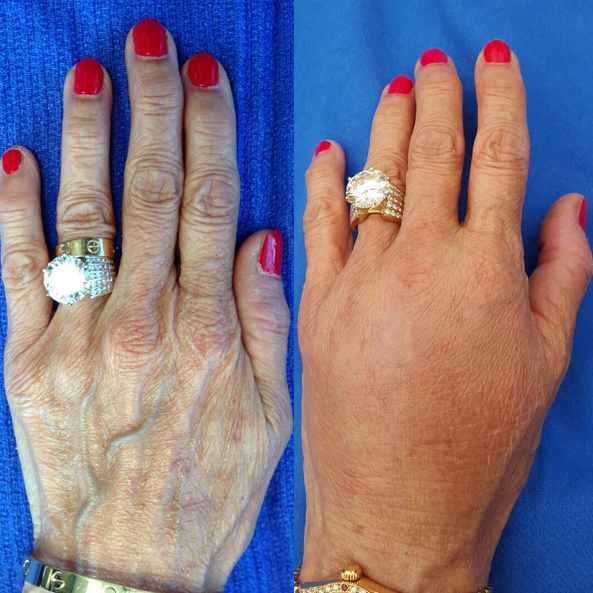
72 year old woman, before and 1 week after hand rejuvenation with Radiesse injectable filler. Radiesse treatment is virtually painless, takes about 2 minutes per hand, and results last for up to 1 year. For more information on Radiesse hand rejuvena…

72 year old woman, before and 1 week after hand rejuvenation with Radiesse injectable filler. Radiesse treatment is virtually painless, takes about 2 minutes per hand, and results last for up to 1 year. For more information on Radiesse hand rejuvenation (or hand rejuvenation with Juvederm, Restylane, or autologous fat grafting) by Dr. Devgan, please call 212-452-2400.

A recent article in Aesthetic Surgery Journal described the technique of lipomodeling (or autologous fat grafting) to the fingers and hands in order to restore a youthful appearance to aging appendages.

Dr. Devgan's expert commentary on this topic, including her use of Radiesse for this procedure, was featured on Healio.com, an online medical journal for physicians.

Click to read the full article on Healio.com

Click to read the full article on Healio.com

​

After age 30, most women's hands look older than their faces. In fact, plastic surgeons often regard the hands as the easiest way to determine a person's age, as aging hands tend to appear more sinewy, veiny, pigmented and thinner than younger hands. This article describes a popular technique for hand rejuvenation: autologous fat grafting.

In my practice, I employ both autologous fat grafting as well as injectable fillers to rejuvenate aging hands. While fat grafting has the advantage of being durable and using one's own tissue, injectable filler (such as Radiesse, Juvederm, or Restylane) is quicker, less expensive, and has a faster recovery. Both techniques are an essential part of a plastic surgeon's armamentarium, and each technique has a role in hand rejuvenation. The authors also draw attention to a valuable finer point in hand rejuvenation: that both the dorsum of the hand and the fingers deserve attention.

Lara Devgan, MD, MPH
Plastic & Reconstructive Surgeon
Diplomate, American Board of Plastic Surgery