Moving personal essay on skin cancer

This is one of the most touching personal essays I have ever read about skin cancer. 

Featured in the New York Times, sports journalist Tim Layden writes lyrically about the basal cell carcinoma on his nose and what it took to repair it. I encourage everyone to read it-- as a piece of literary writing, and equally importantly, as a wake-up call about the devastation that can result from a casual disregard for sun protection. As Layden writes:

 How did I get myself into this mess? The same way that Hemingway’s Mike Campbell went broke in “The Sun Also Rises,” “Gradually, then suddenly.'’


Click to read Tim Layden's full piece.

Click to read Tim Layden's full piece.

Skin cancers are tricky because they often don't play by the rules, but they do have some classic features. 

Basal cell carcinomas are pearly pink, sometimes with an area of bleeding or ulceration, or a central crater, and sometimes with just a subtle area of redness. They are usually found on the nose, ears, face, and neck. These are the most common skin cancers; 30% of Caucasian people will get a basal cell cancer in their lives. 
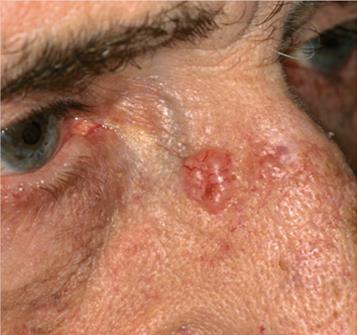
Basal Cell Carcinoma. Image credit medicinenet.com

Basal Cell Carcinoma. Image credit medicinenet.com

Squamous cell carcinomas usually begin as a small reddish plaque. Often they don't have any symptoms, but they can bleed, ulcerate, and change over time. They are common on the lips, face, hands, scalp, and ears, and they metastasize throughout the body. 

Squamous cell carcinoma. Image credit symsys-molemate.com

Squamous cell carcinoma. Image credit symsys-molemate.com

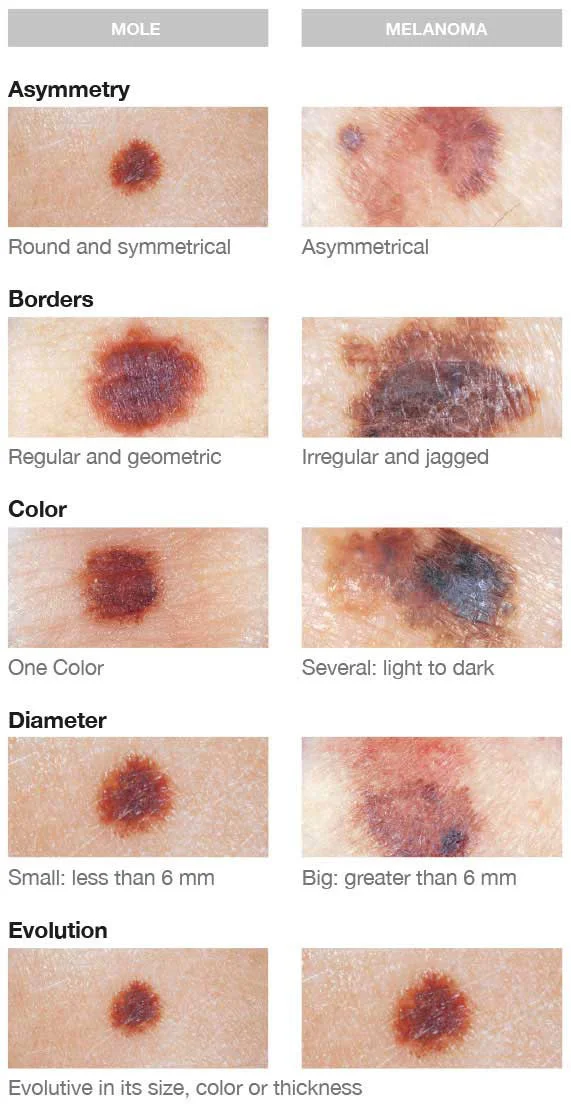
Melanomas are less common than the other two types of skin cancer, but they are the most deadly because of their aggressive tendency to metastasize. They are usually on sun-exposed areas, but can be found anywhere at all, including the eye, the fingernail, and even the bowel. The are usually pigmented, irregular, and evolve over time. The ABCDE nmemonic was developed for melanomas.

Melanoma. Image credit dermatology.org
Melanoma. Image credit dermatology.org

The ABCDE of Melanoma. Image credit Loreal Paris. 

The ABCDE of Melanoma. Image credit Loreal Paris. 

Much of my practice focuses on the excision of suspicious lesions and the reconstruction of skin cancers, so I am especially passionate about this topic.

Make sure you are vigilant about any new freckle, spot, mole, lump, or bump on your body. Skin cancer can happen to anyone, of any skin type-- not just the fair-skinned. When they are caught early, skin cancers are much less disfiguring and much more survivable. Get regular skin checks by a dermatologist. And wear zinc/ titanium based sunscreen everyday.

Dr. Devgan appointed to New York-Presbyterian Healthcare System

We are proud to announce that Dr. Lara Devgan has been appointed to the Attending Surgical Staff of the New York-Presbyterian Healthcare System, at the New York Hospital Queens campus. As an alumna of the residency and fellowship programs at New York-Presbyterian Hospital/ Columbia and Cornell, Dr. Devgan is happy to continue her relationship with these wonderful institutions.

Dr. Devgan's affiliation with the New York-Presbyterian Healthcare System will focus on all aspects of reconstructive surgery, with particular attention to facial fractures and broken noses.

To make an appointment for a cosmetic or reconstructive procedure of any type, please call Dr. Devgan's office at 212.452.2400 or email info@LaraDevganMD.com.

New testimonials from my wonderful patients

I am always flattered to know that I have helped my patients with some facet of their lives. We just updated our website with three new patient testimonials, received via third party websites RealSelf and Vitals. As always, we only publish testimonials that have been independently verified via email and IP address.


"I knew after 1/2 hour with her that she was the one!"

"Dr. Lara is amazing. I went for 2 consultations prior to seeing her. I knew after 1/2 hour with her that she was the one! She also got me to quit smoking. I am now almost 4 months tobacco FREE!" -MW, 52 year old woman, abdominoplasty, via RealSelf.com

"My surgery was flawless and the results astonishing"

"Dr. Devgan was attentive, caring and nurturing. It is great to have a plastic surgeon with sound technical training-- which she has-- but connecting with the patient and establishing the bond is what I valued most. My surgery was flawless and the results astonishing. I would highly recommend her services for plastic surgery and will keep her in my rolodex." -PBP, 34 year old woman, abdominoplasty, via Vitals.com

"A consummate professional... with deep experience and breadth of knowledge" 

"Outstanding. Dr. Devgan is a wonderful doctor. She promptly saw me after I was concerned about a lump on my scalp. She carefully took a sample (with no pain and bleeding) to be analyzed and in less than 48 hours was able to reassure me that it was innocous. She surgically removed the rest of the lump without distorting my hairline. Dr. Devgan is a consummate professional and with her deep experience and breadth of knowledge, I was never worried that I would not get the best possible care. I would recommend her to anyone with reconstructive surgery needs." -Name and age withheld, man, biopsy and excision of large suspicious lesion on scalp, submitted via Vitals.com


Read the blog one of my patients wrote about her experience having surgery performed by me, "Michelle's Tummy Tuck Journey"

Read the blog one of my patients wrote about her experience having surgery performed by me, "Michelle's Tummy Tuck Journey"

A delicious box of chocolates from a patient who had a facelift done by me. Thank you! 

A delicious box of chocolates from a patient who had a facelift done by me. Thank you! 

Dr. Devgan is featured on Mommybites- Does breastfeeding really ruin your breasts?

Does breastfeeding really ruin your breasts?

This article was featured in the "Healthy Living" section of national online women's magazine Mommybites.

By Dr. Lara Devgan

Image credit therantsinmypants.wordpress.com

Image credit therantsinmypants.wordpress.com

When it comes to feeding your baby, pediatricians and lactation consultants agree: breast is best. Breast milk gives your baby the most optimal mix of nutrients, proteins, fats, and antibodies to help him grow strong and healthy. There is even research that shows that breastfeeding decreases rates of breast cancer in women. So what is there not to love?

Well, in between feedings, diaper changes, and the chaos of childrearing, many women worry about what breastfeeding does to their breasts. Those supple curves that were once the centerpiece of feminine mystique have evolved into a combination of baby restaurant, refrigerator, and bottle warmer. They are engorged then deflated. The nipples are raw. They are covered with stretch marks.

Will they ever be the same again?

Unfortunately, the answer is no. Not completely, at least. Unless you are one of the genetically blessed among us, breastfeeding leads to some of the following physiologic consequences in women:

  • Ptosis. This is the medical term for drooping. You may notice after breastfeeding one or more babies that your breasts sit lower on your chest wall than they used to. The nipples might point downward. There may be more contact between the skin on the underside of your breasts and the skin of your chest. If you feel that your breasts look better in a bra, when they are supported higher up on your body, this may mean you have ptosis.
  • Deflation. After breasts go through the process of engorgement and deflation several times a day for weeks or months, they begin to lose their elasticity. This is manifested in the “deflated” look of the top part of the breast. You may notice that your breasts don’t fill your clothes in the same way, or that you don’t have the cleavage you used to have.
  • Skin changes. With weight changes of pregnancy and lactation, the skin may develop stretch marks. Sometimes these will fade over time, as hormonal levels normalize. Other times they will stay. The skin will also lose some of its elasticity– like a rubber band that is a couple of years old, it may not pop right back into a pre-maternity position.

What can you do to fix that?

Image credit postpregnancywellness.com

Image credit postpregnancywellness.com

Wear a well-fitting and supportive bra at all times, even when you are sleeping.

This will reduce some of the burden on your skin and connective tissue to hold up your breasts. You may need a few different bras for the various stages of pregancy and breastfeeding, when your breast size may fluctuate.

Keep your skin well moisturized.

There isn’t one “magic bullet” stretch mark cream on the market that has been proven to work in all women. However, research does show that using a hypoallergenic lotion to keep your skin hydrated can keep you looking younger. Don’t bother spending a fortune on a pricey department store brand. An unscented body lotion from the drug store will be just fine.

Try to pump or nurse on a somewhat regular schedule.

Keeping your breasts from getting maximally engorged before expectorating the milk can help limit the swing in breast size from one extreme to the other -which in turn reduces some of the tissue damage that can come with breastfeeding.

See your doctor or lactation consultant if you have cracked nipples, bleeding, or warm red breasts.

These can all be signs of a medical problem that needs to be addressed right away.

And what about after you wean your baby?

Image credit pacificmotionbirth.com

Image credit pacificmotionbirth.com

If you have stopped breastfeeding and you are unhappy with the way your breasts look, there are many options for a “mommy makeover” of your chest. These include a breast lift, breast augmentation (implants), a breast lift with implants, and a breast reduction.

Plastic surgery on your breasts is not recommended if you have breastfed in the previous six months. If you are over 40 or you have a personal or family history of breast or ovarian cancer, you will probably need a mammogram before having any kind of breast surgery. And of course, medical advice is best given by a well-trained plastic surgeon who has actually examined you and seen you as a patient.

The good news is that cosmetic breast surgery is quite safe, extremely common, and makes many women very happy. Breast implants are one of the most commonly performed plastic surgery procedures in America, and they are safe for future breastfeeding if you decide to have more kids later. Moreover, they have not been shown to delay the detection of breast cancer, which is something that women are sometimes afraid of.

If you think cosmetic breast surgery may be right for you, talk to your plastic surgeon.


Click to read Dr. Devgan's article on Mommybites

Click to read Dr. Devgan's article on Mommybites

Try our new breast implant simulator

If you think you might be interested in breast augmentation, this simulator is a great way to get a sense of how your unique body type might look after surgery. Adjust the settings to get a better idea of what Dr. Devgan can help you achieve. 

For more information on breast augmentation you can also watch our tutorial video. 

Click here to visit our Breast Augmenation page.